
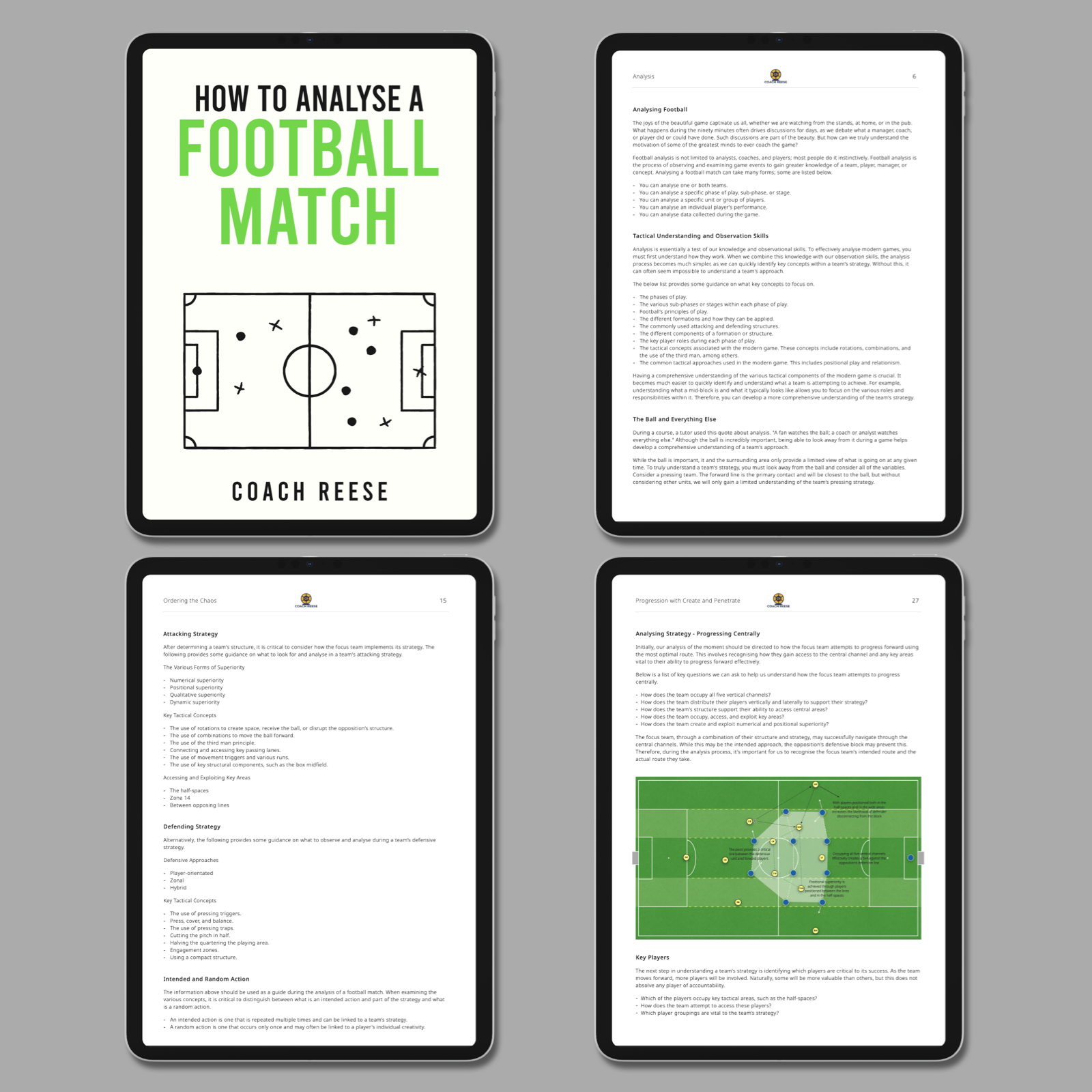
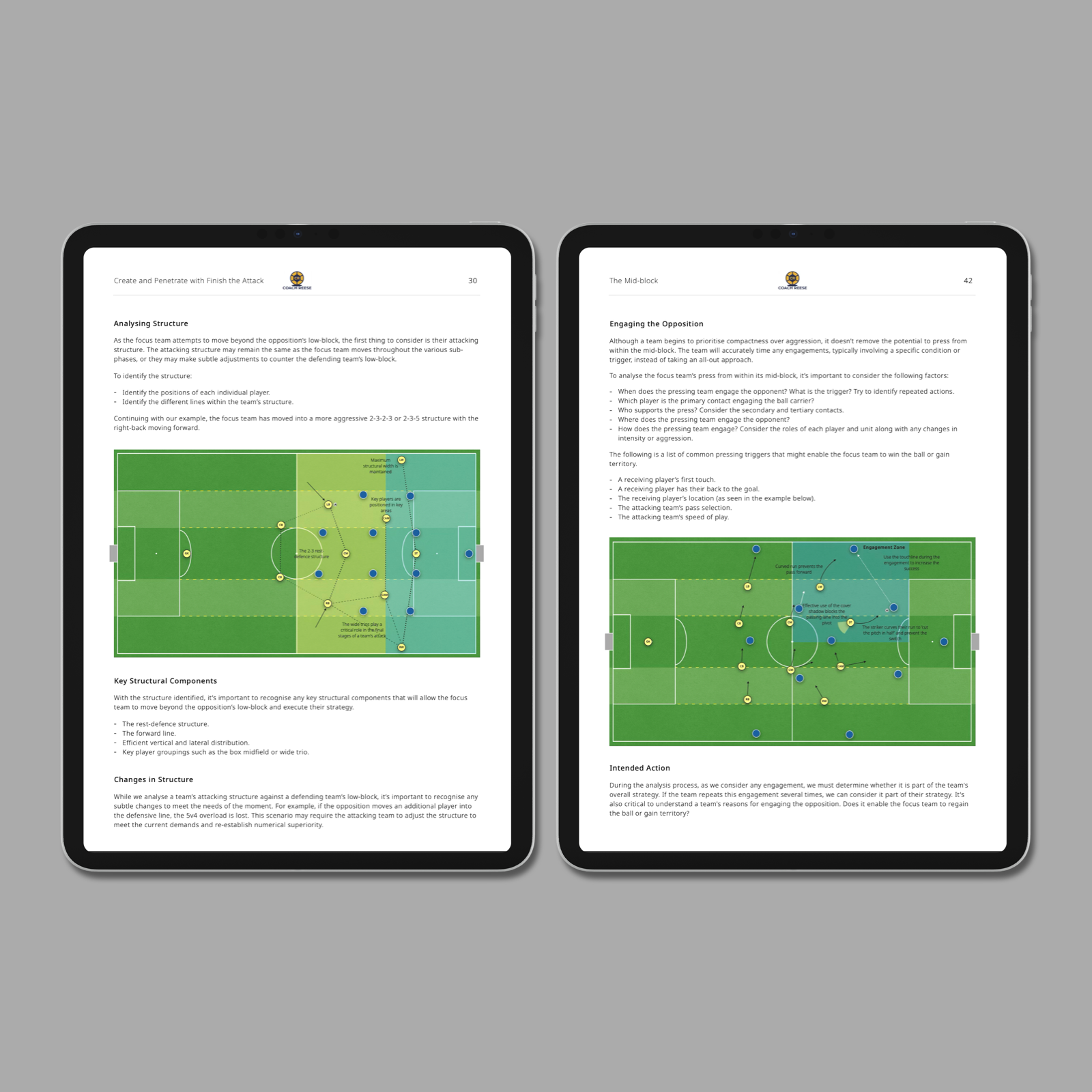
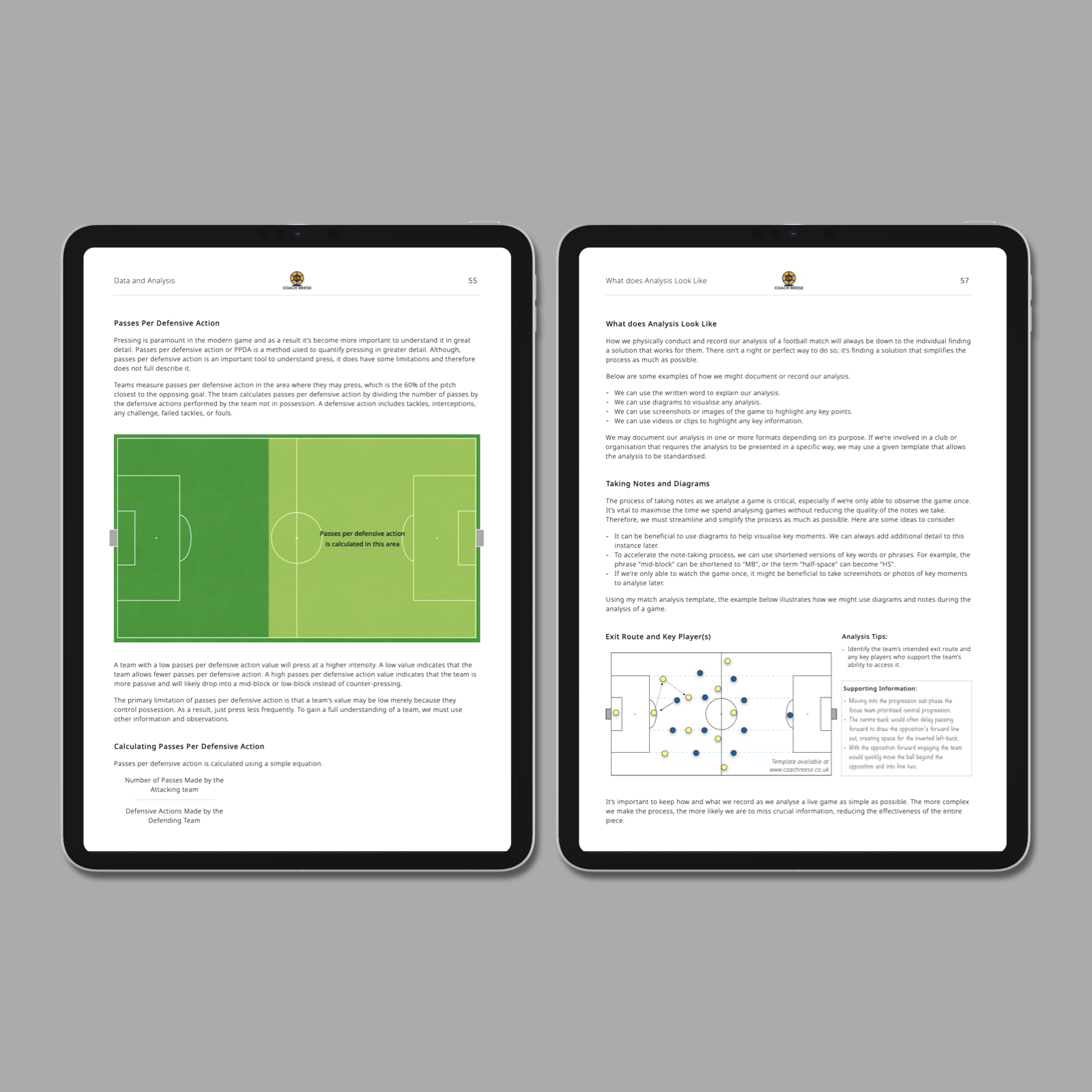
Description
HOW TO ANALYSE A FOOTBALL MATCH
Watch the Game. Understand the Game.
The complete practical guide to analysing a football match — from the first whistle to the final decision.
What should you actually look for when analysing a football match?
How do you understand what each team is trying to do?
How do you analyse a team’s formation and structure?
How do you identify their strengths and weaknesses?
How do you analyse possession, pressing, transitions and chances?
How do you move beyond simply describing what happened?
This book explains how to analyse football properly.
Written by a professional football coach and coach developer, it provides a clear and practical framework for watching matches, identifying patterns, understanding tactical decisions and turning observations into meaningful analysis.
For coaches. Players. Analysts. And anyone who wants to understand football at a deeper level.
MORE THAN WATCHING FOOTBALL
Watching a match is easy.
Understanding what you are watching is different.
Good analysis is not simply writing down what happened.
It is about identifying:
- What each team is trying to do
- How they are trying to do it
- Why they are successful
- Why they struggle
- What changes during the game
- How players and teams respond
- What patterns repeatedly appear
The aim is to move from:
“What happened?”
to:
“Why did it happen?”
and ultimately:
“What can we learn from it?”
A FRAMEWORK FOR ANALYSING THE GAME
A clear structure helps make analysis more consistent.
This book provides a framework for analysing:
- Team structure
- Formations
- Player roles
- Possession
- Build-up
- Moving through the Pitch
- Creating and exploiting space
- Chance creation
- Defensive organisation
- Pressing
- Transitions
- Set plays
- Individual performances
- Decision-making
- Game states
- Tactical adjustments
Instead of watching everything at once, learn how to break the game down.
See the detail. Understand the bigger picture.
START WITH THE BIG PICTURE
Before analysing individual actions, understand the game.
What is the context?
What are the teams trying to achieve?
What is the score?
What happened before the match?
What are the strengths and weaknesses of each team?
How might the opposition influence the game?
What does each team need from the match?
Context changes analysis.
A team leading 1–0 in the 85th minute may behave very differently from the same team at 0–0 in the 10th minute.
ANALYSING TEAM STRUCTURE
Formation is only the starting point.
A team may be listed as a 4-3-3, but what does it actually become during the game?
Analyse:
- Starting formation
- In-possession structure
- Out-of-possession structure
- Defensive block
- Pressing shape
- Build-up structure
- Attacking rotations
- Width
- Depth
- Central occupation
- Player relationships
- Changes between phases
Don’t just identify the formation. Understand the structure.
ANALYSING THE PHASES OF PLAY
Break the match into its key phases.
BUILD-UP
How does the team start attacks?
Where are the centre-backs?
What do the full-backs do?
How does the goalkeeper contribute?
Where do midfielders position themselves?
How does the opposition press?
MOVING THROUGH THE PITCH
How does the team progress?
How do they create passing options?
Where do they find space?
Do they play through, around or over pressure?
How do players rotate?
CREATING & EXPLOITING SPACE
Where does space appear?
Who creates it?
Who attacks it?
How does the opposition respond?
CHANCE CREATION
How does the team enter the final third?
How do they create chances?
Crosses?
Combinations?
Runs beyond?
Cut-backs?
Set plays?
Individual actions?
DEFENSIVE ORGANISATION
How does the team protect the goal?
How compact are they?
Which spaces do they protect?
Where do they allow the opposition to play?
PRESSING
When do they press?
What triggers the press?
Where do they direct the opposition?
How do they cover?
What happens when the first press is beaten?
TRANSITIONS
What happens immediately after possession changes?
Do they counter-press?
Do they recover?
Do they attack quickly?
Do they secure possession?
Do they exploit disorganisation?
The phases give your analysis structure.
ANALYSING POSSESSION
Possession statistics only tell part of the story.
A team can have 65% possession and still struggle to control the game.
Analyse:
- Where possession takes place
- How possession begins
- How it progresses
- Passing options
- Support
- Movement
- Width
- Depth
- Space
- Pressure
- Tempo
- Direction
- Penetration
- Security
- Switching play
Ask:
What is the team trying to achieve with possession?
ANALYSING SPACE
Space is one of the most important concepts in football.
Learn to identify:
- Where space exists
- How space is created
- Who occupies it
- Who attacks it
- Who protects it
- How movement changes it
- How the opposition controls it
Look beyond the player with the ball.
Sometimes the most important movement is made by the player who doesn’t receive it.
ANALYSING PRESSING
Pressing is more than running towards the ball.
Analyse:
- Starting position
- Pressing triggers
- Direction of the press
- Player distances
- Cover
- Balance
- Passing-lane protection
- Pressing traps
- Supporting players
- What happens if the press is beaten
Ask:
Why did they press there?
What were they trying to force?
What happened when the opposition escaped?
ANALYSING TRANSITIONS
Some of the most important moments happen immediately after possession changes.
ATTACK → DEFENCE
What happens after losing the ball?
Do players counter-press?
Who reacts first?
Can they stop the first pass?
Do they protect the centre?
How quickly do they recover?
DEFENCE → ATTACK
What happens after winning the ball?
Is the first action forward?
Can they attack space?
Do they counter-attack?
Who supports?
When do they slow the game down?
Transitions reveal a team’s mentality, organisation and preparation.
ANALYSING PLAYER ROLES
Don’t analyse players only by position.
Analyse their role within the team.
What does the player do:
- In possession?
- Out of possession?
- In transition?
- During build-up?
- During progression?
- Around the box?
- When pressing?
- When defending?
Look at:
Positioning.
Movement.
Scanning.
Decision-making.
Execution.
Relationships.
A player’s role can change throughout the match.
ANALYSING INDIVIDUAL DECISION-MAKING
Good analysis looks beyond successful and unsuccessful actions.
Why did the player make that decision?
What information did they have?
What options were available?
What was the pressure?
What was the game state?
Could they have:
- Passed?
- Carried?
- Dribbled?
- Secured possession?
- Played forward?
- Supported?
- Penetrated?
- Pressed?
- Recovered?
Analyse the decision — not just the outcome.
ANALYSING CHANCES
Not every shot tells the same story.
Understand how chances are created.
Analyse:
- Where the attack started
- How the team progressed
- How space was created
- Movement around the box
- Number of players attacking
- Type of delivery
- Combination play
- Defensive errors
- Counter-attacks
- Set plays
- Final action
- Quality of decision-making
Then ask:
Was the chance created by design, execution, opposition error — or a combination of all three?
ANALYSING GAME STATES
Football changes depending on the score.
Analyse how teams behave when:
- Winning
- Losing
- Drawing
- Scoring
- Conceding
- Playing against ten
- Chasing the game
- Protecting a lead
Does the team change its structure?
Does the press change?
Does possession change?
Do players take more risks?
Does the opposition become more aggressive?
The game state is part of the analysis.
ANALYSING TACTICAL CHANGES
Matches evolve.
Coaches change things.
Players adapt.
Opponents respond.
Learn to identify:
- Formation changes
- Role changes
- Substitutions
- Pressing changes
- Changes in block height
- Changes in width
- Changes in build-up
- Changes in attacking structure
- Changes in defensive responsibilities
Most importantly:
Why did the change happen?
And:
Did it work?
FROM OBSERVATION TO ANALYSIS
Observation:
“The full-back moved inside.”
Analysis:
“The full-back moved inside to create an additional central player and help the team play through the opposition press.”
Observation:
“The striker dropped deep.”
Analysis:
“The striker dropped between the lines to create a dilemma for the centre-back and open space for the winger to attack.”
Observation:
“The team pressed high.”
Analysis:
“The team used a high press to prevent central progression and force the opposition towards the touchline.”
Analysis explains the football behind the action.
IDENTIFYING PATTERNS
One action may be random.
Repeated actions reveal patterns.
Look for:
- Repeated movements
- Repeated passing sequences
- Repeated pressing triggers
- Repeated overloads
- Repeated weaknesses
- Repeated defensive behaviours
- Repeated transitions
- Repeated opportunities
Ask:
Did this happen once — or is it a pattern?
This is where analysis becomes valuable.
STRENGTHS & WEAKNESSES
Every team has strengths.
Every team has vulnerabilities.
Learn to identify both.
ATTACKING STRENGTHS
- Build-up
- Possession
- Progression
- Width
- Combinations
- Individual quality
- Transitions
- Set plays
DEFENSIVE STRENGTHS
- Compactness
- Pressing
- 1v1 defending
- Organisation
- Protecting central areas
- Defending crosses
- Transition defence
Then identify:
Where can the opposition hurt them?
Where can they be exposed?
USING VIDEO EFFECTIVELY
Good analysis is not about watching the same match endlessly without a plan.
Learn how to structure your viewing.
Watch the whole game.
Review key moments.
Re-watch phases.
Focus on individual players.
Look at team structure.
Track patterns.
Use timestamps.
Create clips.
Compare moments.
Build evidence.
Watch with a question.
BUILDING AN ANALYSIS REPORT
Turn your observations into something useful.
A clear report can include:
- Match context
- Team structures
- In-possession analysis
- Out-of-possession analysis
- Pressing
- Transitions
- Chance creation
- Individual roles
- Strengths
- Weaknesses
- Key patterns
- Tactical changes
- Key conclusions
The goal is not to write more.
The goal is to communicate better.
FROM ANALYSIS TO ACTION
Analysis becomes most valuable when it leads to action.
For coaches:
What can we train?
For players:
What can I improve?
For analysts:
What evidence can I provide?
For teams:
What can we exploit?
For opposition analysis:
How can we prepare?
For player development:
What behaviour needs to change?
Analysis should influence what happens next.
THE ANALYST’S QUESTIONS
Throughout the book, you’ll learn to ask better questions.
What happened?
Why did it happen?
Where did it happen?
When did it happen?
Who was involved?
What information was available?
What was the team trying to achieve?
What did the opposition do?
Was it a pattern?
What was the consequence?
What could happen next time?
These questions transform the way you watch football.
ANALYSING THE WHOLE GAME
The best analysts don’t watch isolated moments.
They connect them.
A pressing decision can affect possession.
Possession can affect progression.
Progression can affect chance creation.
Chance creation can affect transitions.
Transitions can affect defensive organisation.
Everything is connected.
The match is one game — not seven separate phases.
WATCH FOOTBALL DIFFERENTLY
Once you understand how to analyse a match, watching football changes.
You start seeing:
- Space
- Structure
- Relationships
- Movement
- Pressing triggers
- Overloads
- Player roles
- Tactical adjustments
- Decision-making
- Patterns
- Transitions
You stop simply watching the ball.
You start watching the game.
FOR COACHES
Use match analysis to:
- Prepare for opponents
- Review your own team
- Identify training needs
- Develop players
- Understand tactical problems
- Evaluate your Game Model
- Improve decision-making
- Support your coaching process
Turn what you see into what you coach.
FOR PLAYERS
Learn how to watch yourself and others.
Understand:
- Positioning
- Movement
- Decision-making
- Space
- Support
- Pressing
- Transitions
- Player relationships
- Tactical responsibilities
Don’t just watch your position. Watch the game around you.
FOR ANALYSTS
Develop a clear process for:
- Observation
- Data collection
- Video analysis
- Pattern recognition
- Tactical analysis
- Individual analysis
- Opposition analysis
- Report writing
- Presentation
- Communication
Make your analysis clear, relevant and actionable.
FOR THE FOOTBALL CURIOUS
You don’t need to be a professional coach or analyst to understand football.
If you’ve ever wondered:
Why did the full-back move there?
Why did the midfielder drop?
Why did the striker press?
Why did the team switch play?
Why was that space available?
Why did the press fail?
Why did the goal happen?
This book helps you find the answers.
WRITTEN FROM THE PROFESSIONAL GAME
Written by a professional football coach and coach developer, this book brings together the principles used to understand football at a deeper level.
It is designed to make match analysis:
Clear.
Practical.
Structured.
Meaningful.
And most importantly:
Useful.
TRUSTED BY PROFESSIONALS
Danny Röhl — Football Manager
Gaël Clichy — Former Manchester City & Arsenal player, Coach
Yohan Cabaye — Former Newcastle United & PSG player, Coach
Martin Devaney — Assistant Manager, Barnsley FC
Marlon Pack — Portsmouth Captain
Kenwyne Jones — Former Premier League player, Coach
Football ideas that can be understood, applied and developed.
UNDERSTAND THE GAME BEHIND THE GAME
HOW TO ANALYSE A FOOTBALL MATCH
A complete practical guide to watching, understanding and explaining football.
Match context. Team structure. Formations. Player roles. Possession. Space. Build-up. Moving through the Pitch. Chance creation. Defensive organisation. Pressing. Transitions. Decision-making. Patterns. Tactical changes. Individual analysis. Opposition analysis.
For coaches. Players. Analysts. Fans. And football aficionados.
See more. Understand more. Analyse better.
WATCH THE GAME. UNDERSTAND THE GAME.
Learn how to analyse football with a clear framework you can use every time you watch a match.
LEARN HOW TO ANALYSE THE GAME

Reviews
There are no reviews yet.