
Description
THE CENTRAL MIDFIELDER
Understand the Role. Control the Game.
The complete practical guide to understanding the role of the Central Midfielder in modern football.
What does a central midfielder actually do?
Where should they position themselves?
How do they help their team build from the back?
When should they move towards the ball?
When should they move away?
How do they create passing options?
When should they play forward?
When should they carry the ball?
How do they support attacks?
How do they defend?
When should they press?
How do they protect the team in transition?
And what does it really take to control the game from midfield?
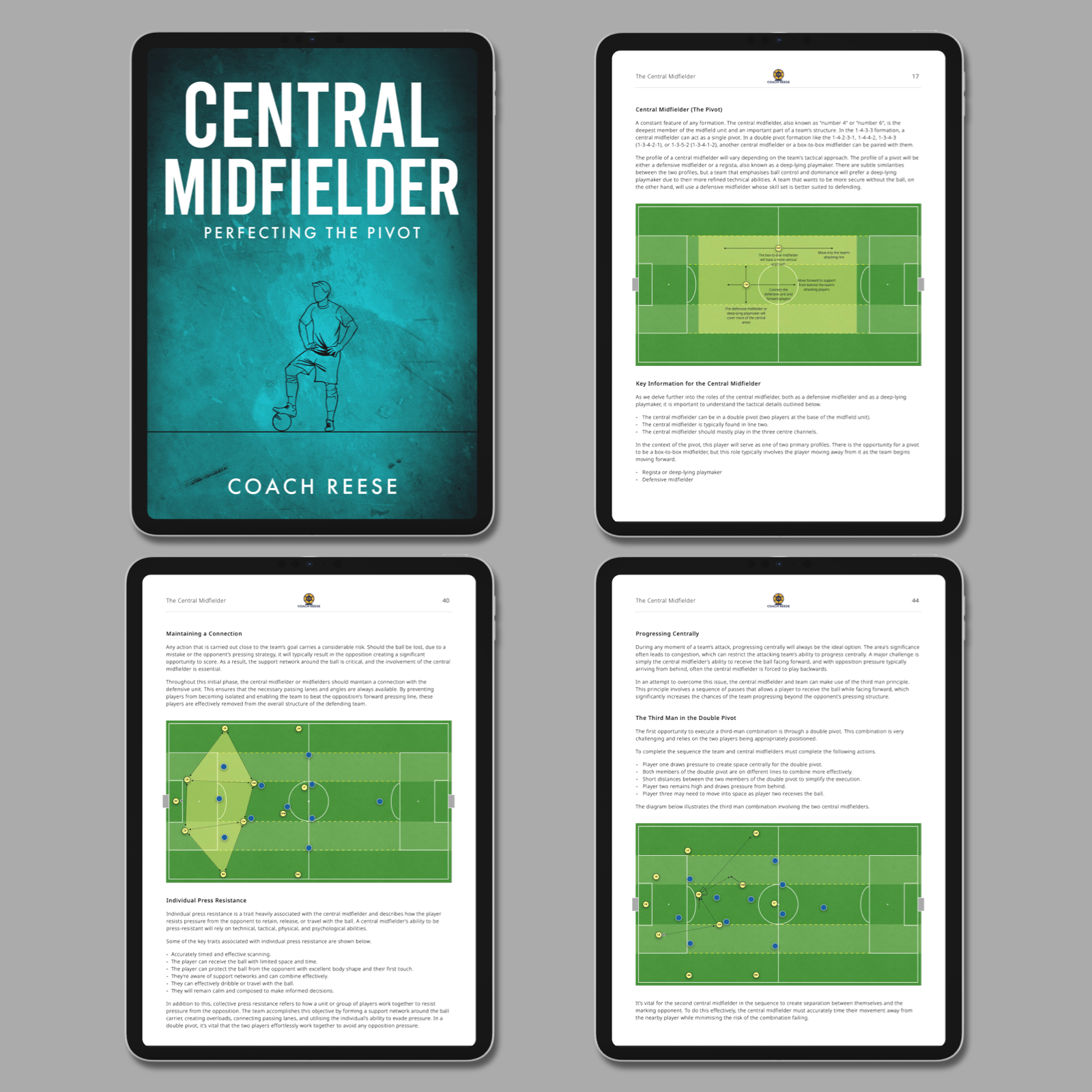
The Central Midfielder provides a complete explanation of one of the most important and demanding roles on the football pitch.
Written by a professional football coach and coach developer, this book explains the responsibilities, behaviours, decisions and skills required to play the position effectively.
For players. Coaches. Analysts. Fans. And football aficionados.
MORE THAN JUST A POSITION
Being a central midfielder isn’t simply about playing in the middle of the pitch.
It is about understanding:
Where to be.
When to move.
What to see.
When to receive.
Where to play.
When to support.
When to penetrate.
When to press.
When to recover.
The central midfielder connects the different parts of the team.
They influence the game with and without the ball.
They help their team:
Build.
Progress.
Create.
Defend.
Press.
Transition.
Understand the position.
Understand the game.
THE CENTRAL MIDFIELDER ACROSS EVERY PHASE
The role changes depending on what is happening in the game.
A central midfielder must understand their responsibilities across every phase.
BUILD-UP
Where should I position myself?
How can I provide an option for the defenders?
How can I create passing angles?
When should I drop?
When should I stay higher?
How can I help the team play through pressure?
MOVING THROUGH THE PITCH
How can I help progress the ball?
Can I receive between lines?
Can I play forward?
Can I carry?
Can I support the player in possession?
Can I create a numerical advantage?
CREATING & EXPLOITING SPACE
Where is the space?
How can I create it?
Can I occupy it?
Can I move an opponent?
Can I create space for a teammate?
CHANCE CREATION
Can I support the attack?
Can I arrive in the box?
Can I create a final pass?
Can I combine around the penalty area?
Can I provide a different attacking option?
DEFENSIVE ORGANISATION
Where should I position myself?
What space do I protect?
Who do I screen?
How do I support the defensive line?
How do I stay connected to teammates?
PRESSING
When should I press?
What is the trigger?
Where do I show the opponent?
Who provides cover?
What happens if the first press is beaten?
TRANSITIONS
What do I do when we lose the ball?
What do I do when we win it?
Can I counter-press?
Can I protect space?
Can I support the counter-attack?
Can I help the team regain organisation?
THE CENTRAL MIDFIELDER IN POSSESSION
A central midfielder must constantly provide solutions.
They may need to:
Receive.
Pass.
Carry.
Support.
Rotate.
Create space.
Play forward.
Switch play.
Combine.
Penetrate.
The best midfielders don’t simply ask:
“Where is the ball?”
They ask:
“Where should the ball go next?”
RECEIVING THE BALL
Receiving is one of the central midfielder’s most important actions.
Develop the ability to:
- Scan before receiving
- Receive on the back foot
- Receive across the body
- Receive between opponents
- Receive under pressure
- Receive on the move
- Protect the ball
- Turn
- Play first time
- Prepare the next action
The first touch should help create the next opportunity.
SCANNING & AWARENESS
Central midfielders often receive the ball with pressure coming from multiple directions.
They need to know what is happening before the ball arrives.
Scan:
Before receiving.
As the ball travels.
After receiving.
Look for:
Opponents.
Teammates.
Space.
Pressure.
Passing options.
The next action.
Develop the awareness to make decisions before the pressure arrives.
PASSING FROM MIDFIELD
The central midfielder needs a wide range of passing solutions.
Develop:
Short passing.
Long passing.
Forward passing.
Diagonal passing.
Switches of play.
Through balls.
Passes around pressure.
Passes through pressure.
Passes into space.
Combination passes.
But the key question remains:
Which pass does the game require?
PLAYING FORWARD
Central midfielders can be responsible for progressing the team.
Recognise when to:
Break a line.
Play between opponents.
Find the forward player.
Play into space.
Carry the ball forward.
Support the next action.
But playing forward isn’t always the right answer.
Sometimes the best decision is to retain possession and move the opponent.
CARRYING THE BALL
A central midfielder can influence the game without passing.
Ball carrying can:
- Break a line
- Attack space
- Draw an opponent
- Create a numerical advantage
- Change the point of attack
- Create space for teammates
- Progress the team
Know when to pass, carry or secure possession.
SUPPORTING THE PLAYER IN POSSESSION
Good midfield play is connected.
When one player receives the ball, others must provide solutions.
Support through:
Angles.
Distance.
Width.
Depth.
Forward options.
Behind-the-ball security.
Third-player movements.
Help create a situation where the player in possession has multiple solutions.
MOVEMENT WITHOUT THE BALL
The central midfielder’s work doesn’t stop when they don’t have the ball.
Movement can:
Create space.
Create passing lanes.
Move opponents.
Support teammates.
Provide depth.
Provide width.
Create penetration.
Create a third-player option.
Sometimes the most important movement is the one that doesn’t receive the ball.
POSITIONING
Good midfielders understand where they need to be in relation to:
The ball.
Teammates.
Opponents.
Space.
The goal.
Positioning should provide the team with:
Connection.
Support.
Progression.
Balance.
Security.
The central midfielder is constantly adjusting their position as the game changes.
PLAYING BETWEEN THE LINES
Central midfielders can occupy dangerous areas between the opposition’s lines.
But receiving there requires more than simply standing in space.
Develop the ability to:
Scan.
Recognise the space.
Arrive at the right moment.
Receive on the turn.
Protect the ball.
Combine.
Play forward.
Attack the next space.
CREATING NUMERICAL ADVANTAGES
Central midfielders can help create overloads.
They may:
Drop into build-up.
Rotate with teammates.
Move towards the ball.
Create a 3v2.
Support wide areas.
Join the attack.
Create a third-player option.
Understand how your movement can help the team create an advantage.
COMBINATION PLAY
Central midfield is built around relationships.
Develop combinations with:
Centre-backs.
Full-backs.
Wing-backs.
Other midfielders.
Number 10s.
Wingers.
Strikers.
Use:
One-twos.
Third-player combinations.
Set and play.
Rotations.
Overlaps.
Underlaps.
Pass and move.
The central midfielder helps connect the team.
SWITCHING THE POINT OF ATTACK
The game isn’t always played where the ball is.
Central midfielders can recognise when the opponent has become overloaded on one side.
Then:
Secure possession.
Move the opponent.
Find the opposite side.
Change the point of attack.
The central midfielder can help the team recognise where the opportunity is.
DEFENDING FROM MIDFIELD
The central midfielder has major defensive responsibilities.
They must help:
Protect central areas.
Screen passes.
Track runners.
Cover teammates.
Stay compact.
Prevent progression.
Support the defensive line.
Regain possession.
Defending from midfield begins with positioning and awareness.
PRESSING
Central midfielders play a major role in the team’s pressing structure.
Understand:
When to press.
What triggers the press.
Where to direct the opponent.
Who provides cover.
How to close passing lanes.
When to recover.
What happens if the press is beaten.
Pressing isn’t simply about running.
It is about controlling the opponent’s options.
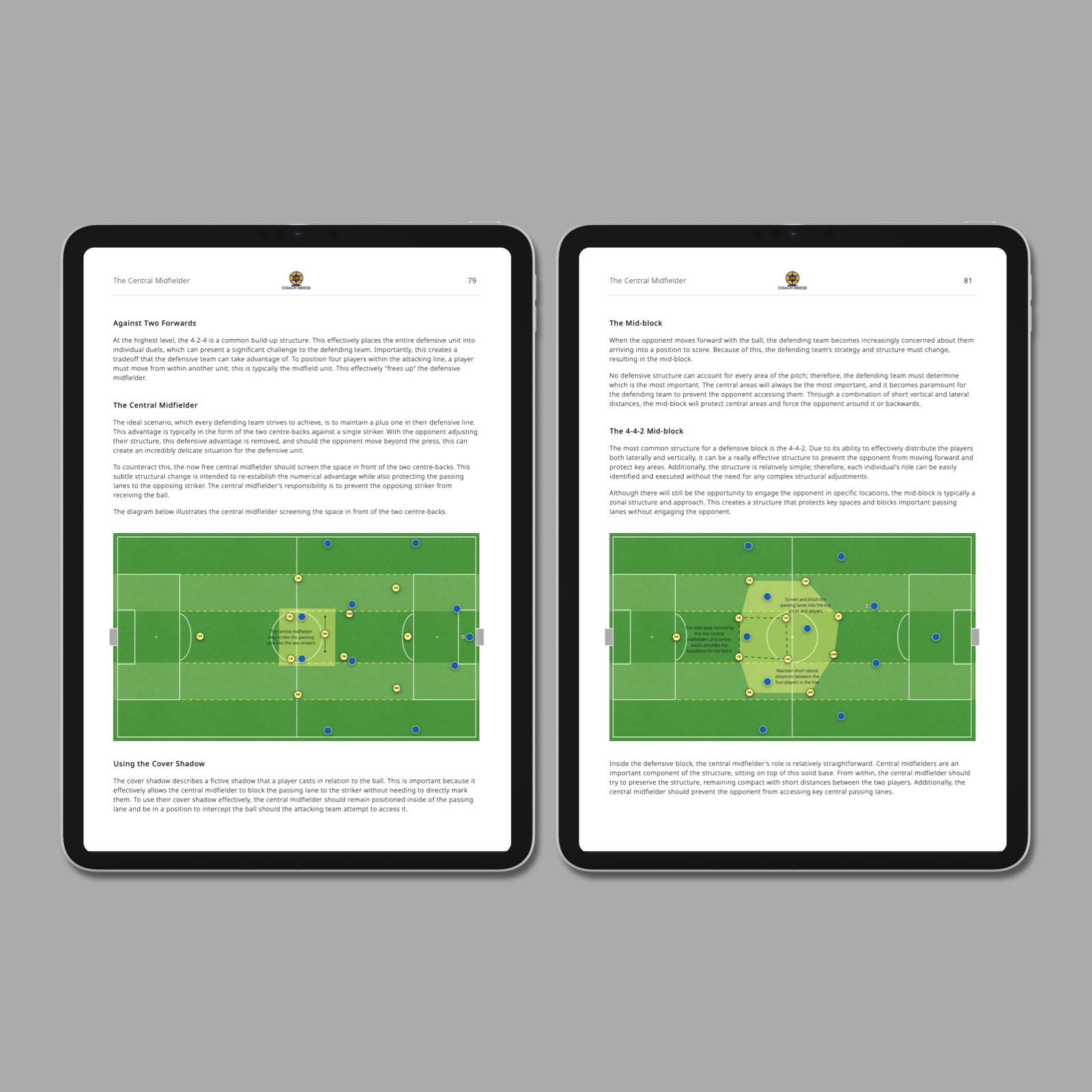
SCREENING & PROTECTING SPACE
Sometimes the midfielder’s most important action is to do nothing with the ball.
Protect:
The space in front of the defence.
Central passing lanes.
Space between lines.
The area around the ball.
Space behind teammates who have pressed.
Good midfielders understand that space is something you defend.
TRACKING & MARKING
Central midfielders may need to deal with:
Opposing midfielders.
Number 10s.
Runners from deep.
Players between the lines.
Wide players moving inside.
Recognise when to:
Track.
Pass on.
Follow.
Hold position.
Protect space.
Defensive responsibility requires awareness of the whole picture.
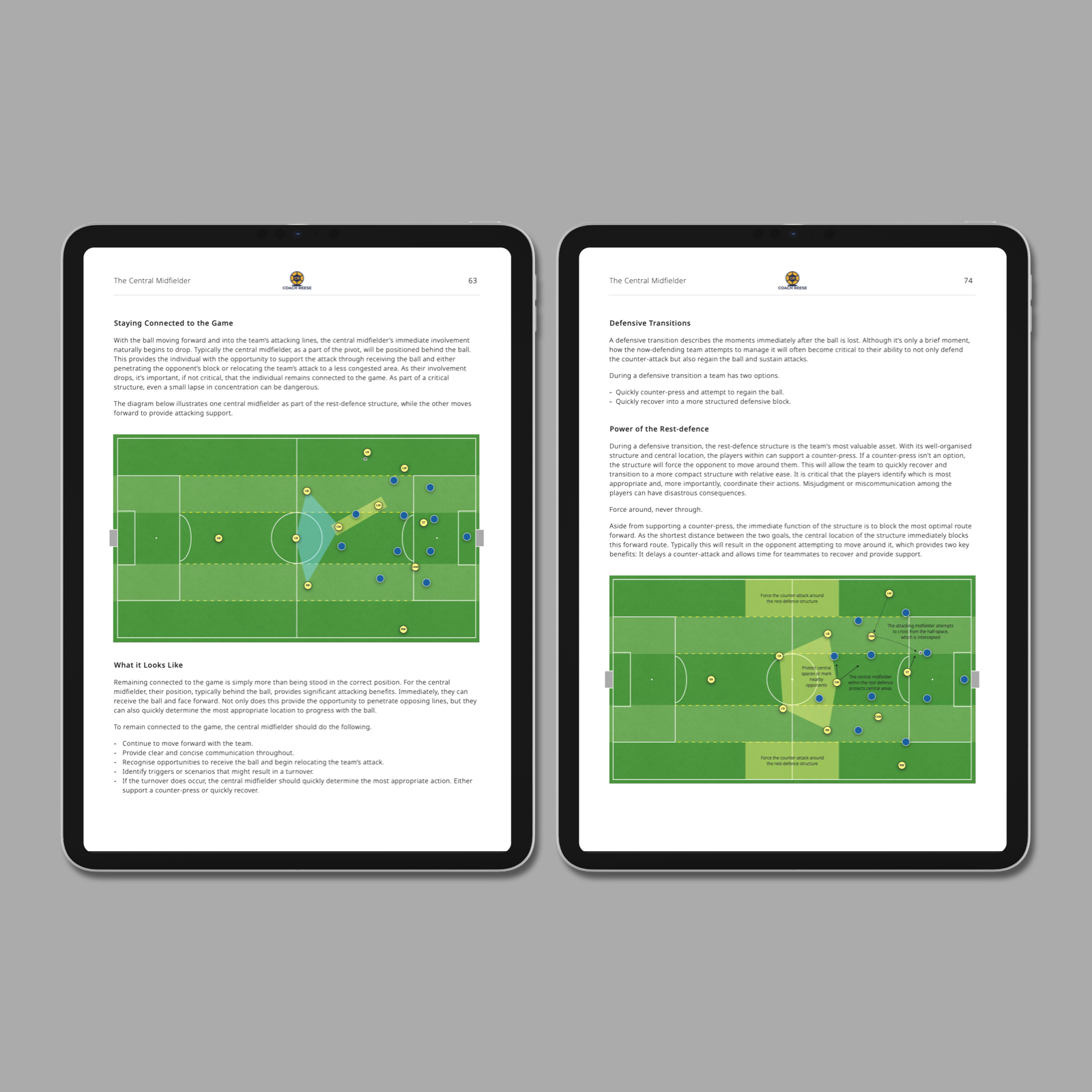
DEFENSIVE TRANSITIONS
The moment the ball is lost, the central midfielder must react.
Ask:
Can I win it back immediately?
Can I counter-press?
Can I stop the first forward pass?
Can I delay the attack?
Can I protect the centre?
Do I need to recover?
The central midfielder can be crucial in stopping the opponent’s counter-attack.
ATTACKING TRANSITIONS
When possession is won, opportunities can appear immediately.
Can the midfielder:
Play forward?
Carry the ball?
Find the forward player?
Attack space?
Support the counter-attack?
Secure possession?
The right decision depends on the game in front of you.
DECISION-MAKING
The central midfielder is constantly making decisions.
Where should I position myself?
When should I move?
Pass or carry?
Forward or sideways?
One touch or two?
Support or penetrate?
Play quickly or secure possession?
Press or recover?
Follow or protect space?
The role demands football intelligence, not simply technical ability.
THE CENTRAL MIDFIELDER & THE TEAM
A central midfielder rarely operates in isolation.
Their decisions affect everyone around them.
The central midfielder can help:
Centre-backs build.
Full-backs progress.
Wingers receive.
Attacking players combine.
Strikers receive forward passes.
Defenders stay protected.
The team remain connected.
Understand your role.
Understand your relationships.
Understand how your actions affect the team.
DIFFERENT TYPES OF CENTRAL MIDFIELDER
There isn’t one single way to play the position.
Central midfielders can have different strengths and profiles.
Some may be:
Controllers.
Progressors.
Ball carriers.
Creators.
Ball winners.
Runners.
Organisers.
All-round midfielders.
The role can change according to:
Team structure.
Game Model.
Teammates.
Opposition.
Game state.
Player profile.
The position provides the framework.
The player brings the interpretation.
THE COMPLETE CENTRAL MIDFIELDER
A complete central midfielder needs more than technical ability.
They need:
Technical quality.
Tactical understanding.
Awareness.
Decision-making.
Movement.
Positioning.
Communication.
Physical capability.
Mentality.
Adaptability.
The objective isn’t to create a midfielder who follows instructions.
It is to develop a midfielder who can understand and influence the game.
WATCH FOOTBALL DIFFERENTLY
Once you understand the central midfielder, watch the position differently.
Watch:
Where they position themselves.
What they scan.
How they receive.
When they move.
What happens before they receive.
Where they play next.
How they support.
How they defend.
When they press.
What they do after losing the ball.
What they do after winning it.
The next time you watch football, watch the midfielder.
FOR PLAYERS WHO WANT TO IMPROVE
Whether you’re:
Young.
Grassroots.
Academy.
Development.
Senior.
Elite.
This book provides a framework for understanding what the position demands.
Learn:
What to look for.
Where to be.
When to move.
What decisions to make.
How to influence the game.
Don’t just play in midfield.
Understand midfield.
FOR COACHES TOO
Use the book to help players understand:
- Positional responsibilities
- Individual behaviours
- Tactical decisions
- Relationships with teammates
- Attacking responsibilities
- Defensive responsibilities
- Pressing
- Transitions
- Decision-making
- Player development
Give players a clearer understanding of the role.
WRITTEN FROM THE PROFESSIONAL GAME
The author is a professional football coach and coach developer, bringing practical coaching experience and a passion for developing players into the explanation of the position.
The aim is simple:
Explain the role.
Develop understanding.
Improve decision-making.
Develop better midfielders.
TRUSTED BY PROFESSIONALS
The author’s eBooks are already being used and endorsed by professionals from the game.
Including:
Danny Röhl — Football Manager
Gaël Clichy — Former Manchester City & Arsenal player, Coach
Yohan Cabaye — Former Newcastle United & PSG player, Coach
Martin Devaney — Assistant Manager, Barnsley FC
Marlon Pack — Portsmouth Captain
Kenwyne Jones — Former Premier League player, Coach
Their use and support of the author’s work reflects the practical focus behind the books:
Football ideas that can be understood, applied and developed.
UNDERSTAND THE ROLE. CONTROL THE GAME.
THE CENTRAL MIDFIELDER
The complete practical guide to understanding the role of the Central Midfielder in modern football.
Build-up.
Progression.
Possession.
Receiving.
Passing.
Ball carrying.
Movement.
Positioning.
Creating space.
Combination play.
Chance creation.
Defending.
Pressing.
Transitions.
Decision-making.
Player profiles.
Professional coaching insight.
For players. Coaches. Analysts. Fans. And football aficionados.
Understand your role. Improve your game.
Learn what it takes to play Central Midfield.
Get your copy today.
Reviews
There are no reviews yet.