
Description
BUILD YOUR FOOTBALL GAME MODEL
Define Your Football. Build Your Game Model.
A practical six-page Game Model builder designed to help coaches define their football philosophy, establish fundamental team principles and develop clear tactical behaviours in and out of possession, transitions and tactical adjustments.
What do you believe about football?
What do you want your team to look like?
What are your fundamental principles?
How do you want your team to play in possession?
How do you want your team to defend?
What happens when possession changes?
And how will you adapt your approach during a game?
This six-page document gives you a clear framework to work through these questions and build your own Game Model.
Written by a professional football coach and coach developer, this is a practical tool for coaches who want to define how they want their team to play — and turn their ideas into clear, coachable behaviours.
MORE THAN JUST A GAME MODEL
A Game Model is more than a formation.
More than a set of tactics.
More than a collection of training practices.
It represents how you want your team to play.
This document helps you connect:
- Your coaching philosophy
- Your beliefs about the game
- Your fundamental team principles
- Your behaviours in possession
- Your behaviours out of possession
- Your transition principles
- Your tactical adjustments
The aim is not to create a rigid script.
It is to create a clear framework that helps players understand how, when and why they should act.
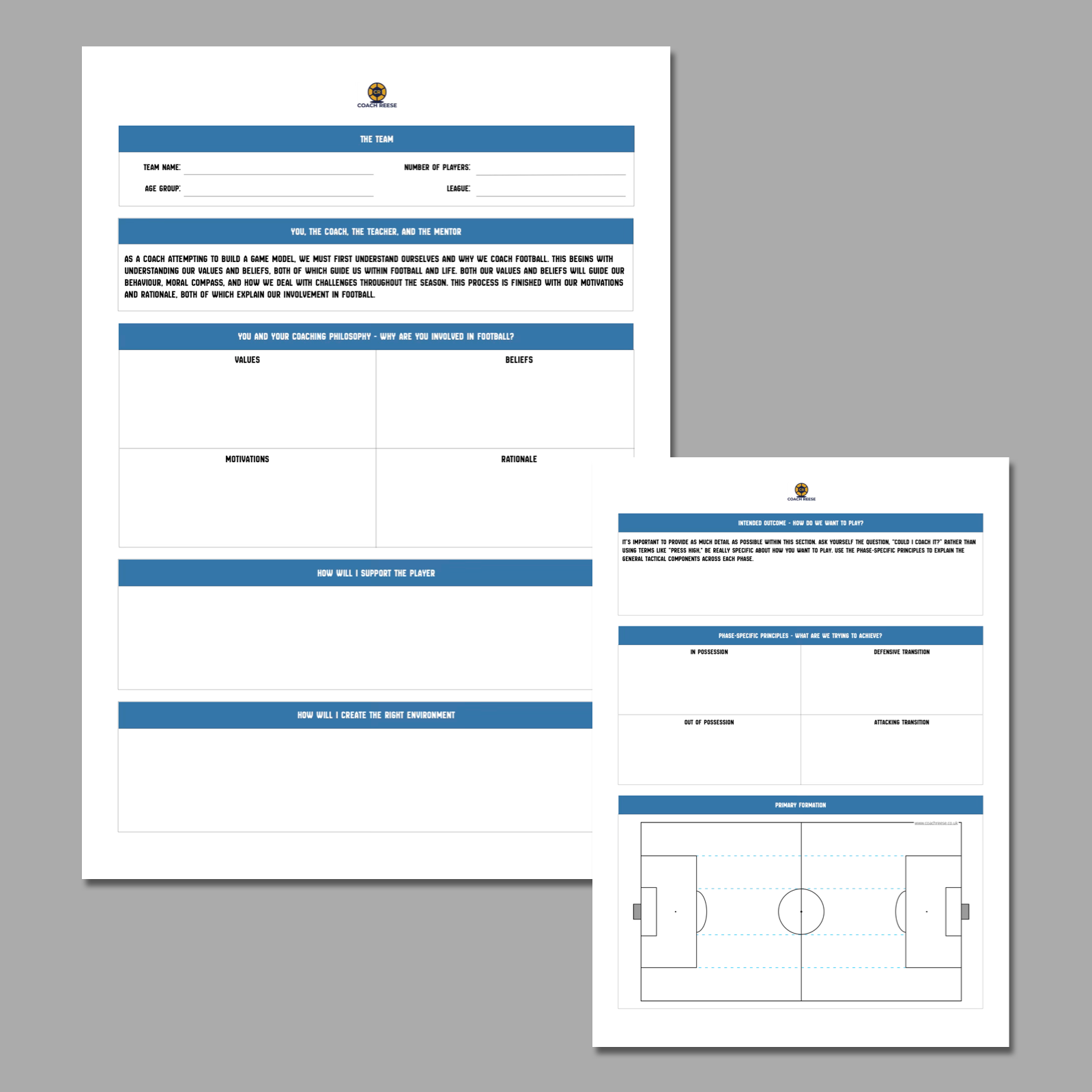
PAGE ONE — YOU THE COACH
Start With Yourself
Before defining how your team plays, you need to understand what you believe.
This first page gives you the opportunity to consider yourself as the coach.
What do you value?
What do you believe good football looks like?
What are your coaching principles?
What do you want your team to represent?
What behaviours do you want to encourage?
What type of environment do you want to create?
Your Game Model should reflect your football philosophy — while also considering your players, your environment and the demands of your team.
Your football starts with you.
PAGE TWO — THE FUNDAMENTAL PRINCIPLES OF YOUR TEAM
Define What Your Team Stands For
Before going into specific phases of play, establish the fundamental principles that underpin your team.
What are the non-negotiables?
How do you want your team to behave?
What should your players recognise regardless of the opposition, formation or game state?
This page helps you define the foundations of your Game Model.
Consider:
- Team identity
- Fundamental principles
- Playing philosophy
- Player behaviours
- Collective behaviours
- Decision-making
- Communication
- Attitude and mentality
- What you want your team to consistently demonstrate
These principles become the foundation for everything that follows.
Clear principles create clear behaviours.
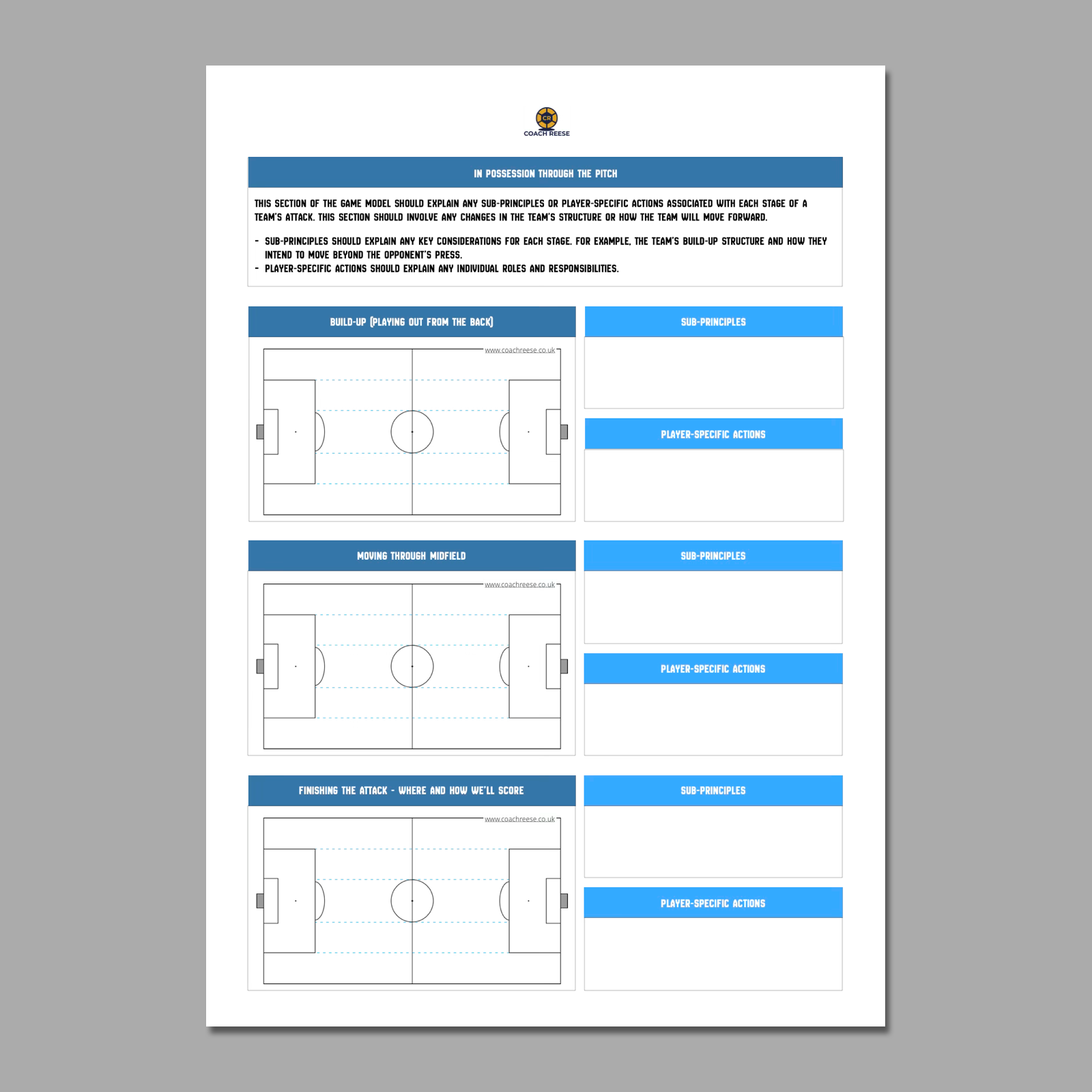
PAGE THREE — IN POSSESSION
How Do You Want Your Team to Play With the Ball?
Now define your team’s approach in possession.
How do you want to build?
How do you want to move through the pitch?
How do you want to create and exploit space?
How do you want to create chances?
Consider the key phases of attacking play:
BUILD-UP
- How do you start attacks?
- How do you create passing options?
- How do you use the goalkeeper and defenders?
- How do you create numerical advantages?
MOVING THROUGH THE PITCH
- How do you progress?
- How do you create support?
- How do you play through, around or over pressure?
- How do you use width and depth?
CREATING & EXPLOITING SPACE
- How do you move opponents?
- Where do you want to create space?
- How do players rotate?
- How do you create overloads and isolations?
CHANCE CREATION
- How do you enter the final third?
- How do you attack the box?
- How do you create finishing opportunities?
- How do you maintain balance behind the ball?
Your Game Model should give players reference points, not dictate every action.
Give players a framework. Allow them to play.
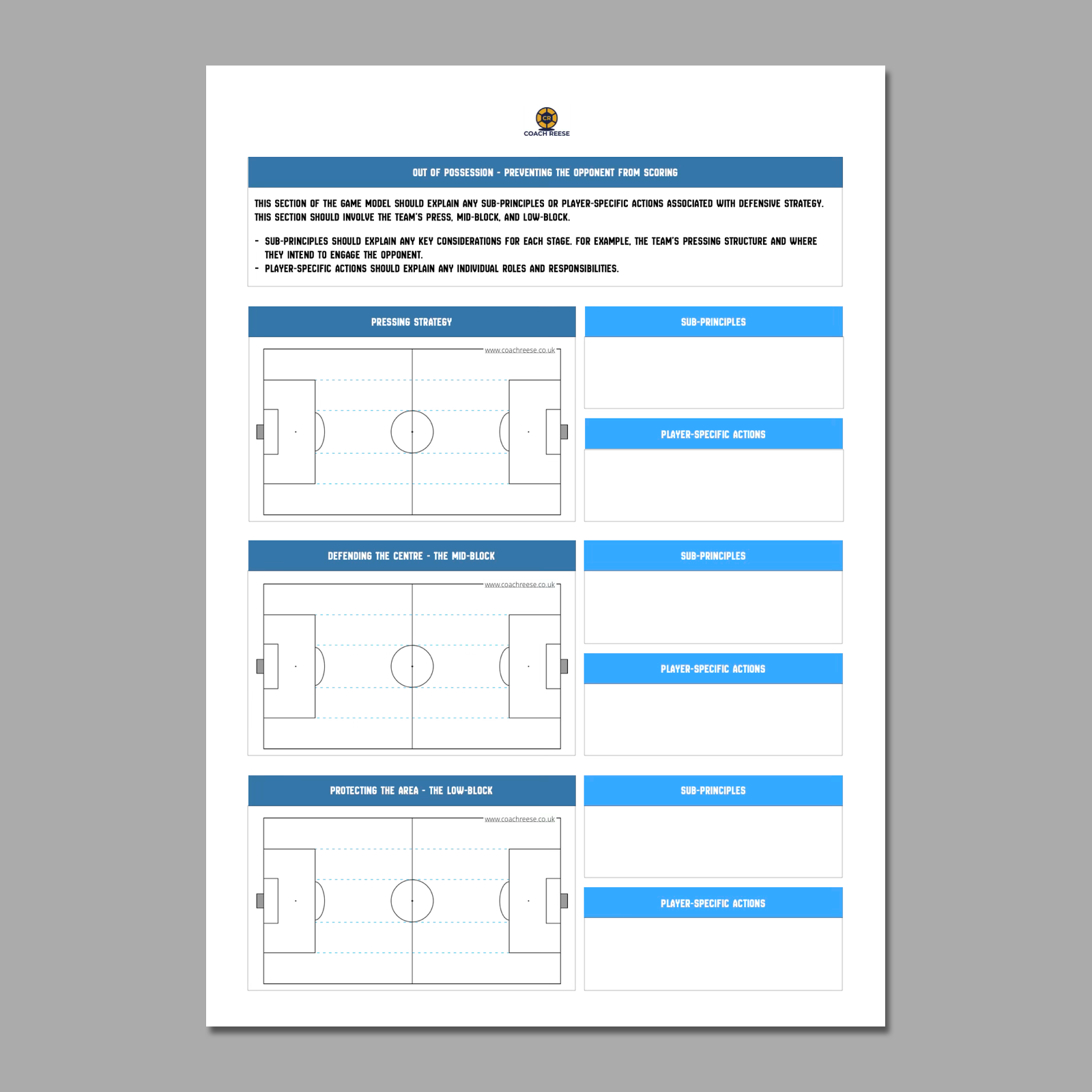
PAGE FOUR — OUT OF POSSESSION
How Do You Want Your Team to Defend?
Define how your team behaves when you don’t have the ball.
How do you want to organise?
Where do you want to defend?
How do you want to press?
How do you want to prevent the opposition from progressing?
Consider:
- Defensive organisation
- Compactness
- Protecting central areas
- Controlling space
- Pressing principles
- Pressing triggers
- Direction of the press
- Cover and balance
- Preventing forward passes
- Defending wide areas
- Defending the box
- Regaining possession
Think about the relationship between the individual and the collective.
How one player acts should help determine how the rest of the team behaves.
Your defensive principles should give players a clear understanding of what they are trying to achieve and why.
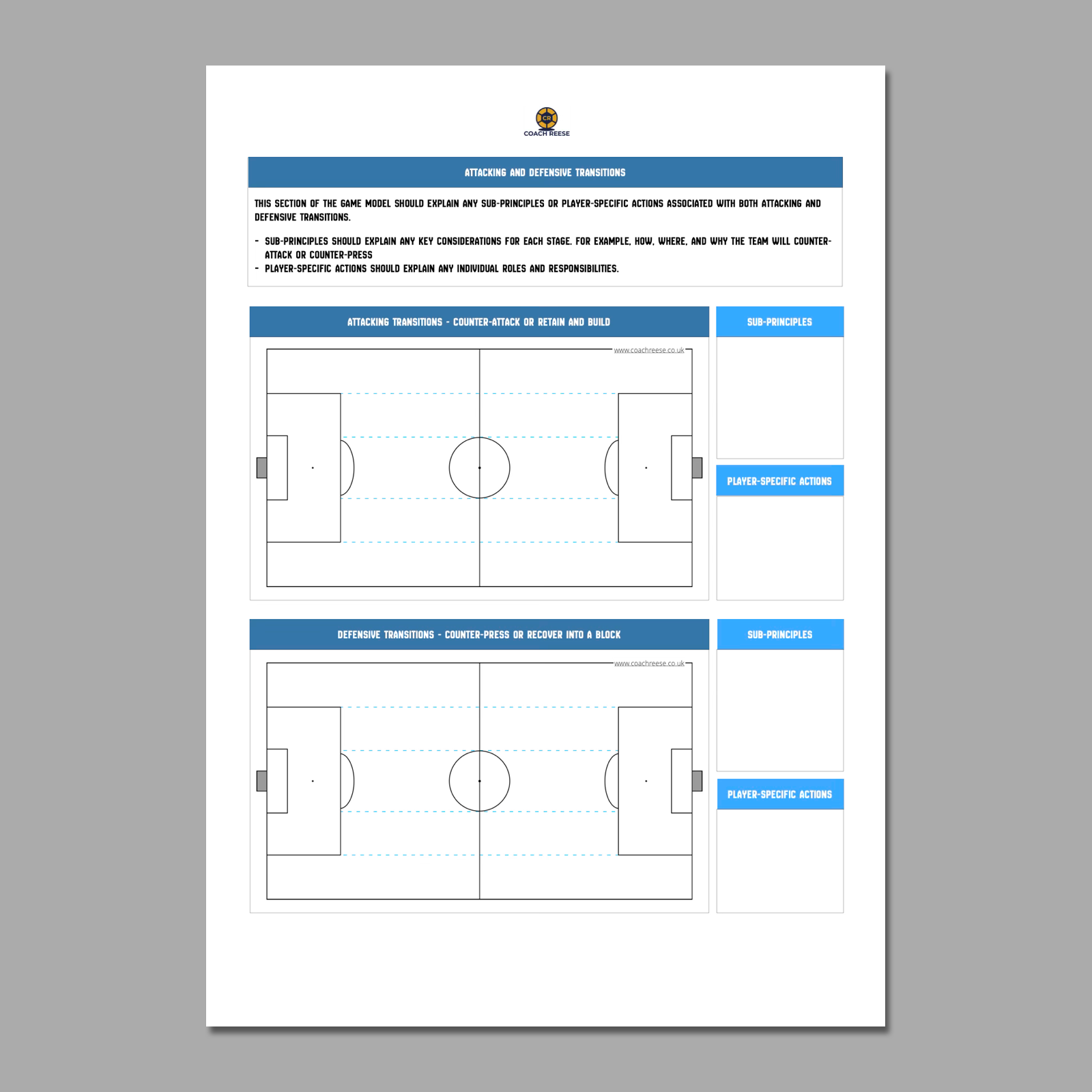
PAGE FIVE — TRANSITIONS
What Happens When Possession Changes?
Transitions are moments of opportunity and vulnerability.
What does your team do immediately after losing the ball?
What does your team do immediately after winning it?
Define your principles for both moments.
ATTACK TO DEFENCE
- Can you counter-press?
- Can you regain immediately?
- How do you stop the first forward pass?
- How do you protect the centre?
- How do you delay the counter-attack?
- How quickly do you recover your defensive structure?
DEFENCE TO ATTACK
- Can you play forward?
- Can you attack space?
- Can you exploit opposition disorganisation?
- Who provides support?
- When should you accelerate?
- When should you secure possession?
Transitions connect your attacking and defensive principles.
What happens in the next five seconds can define what happens next.
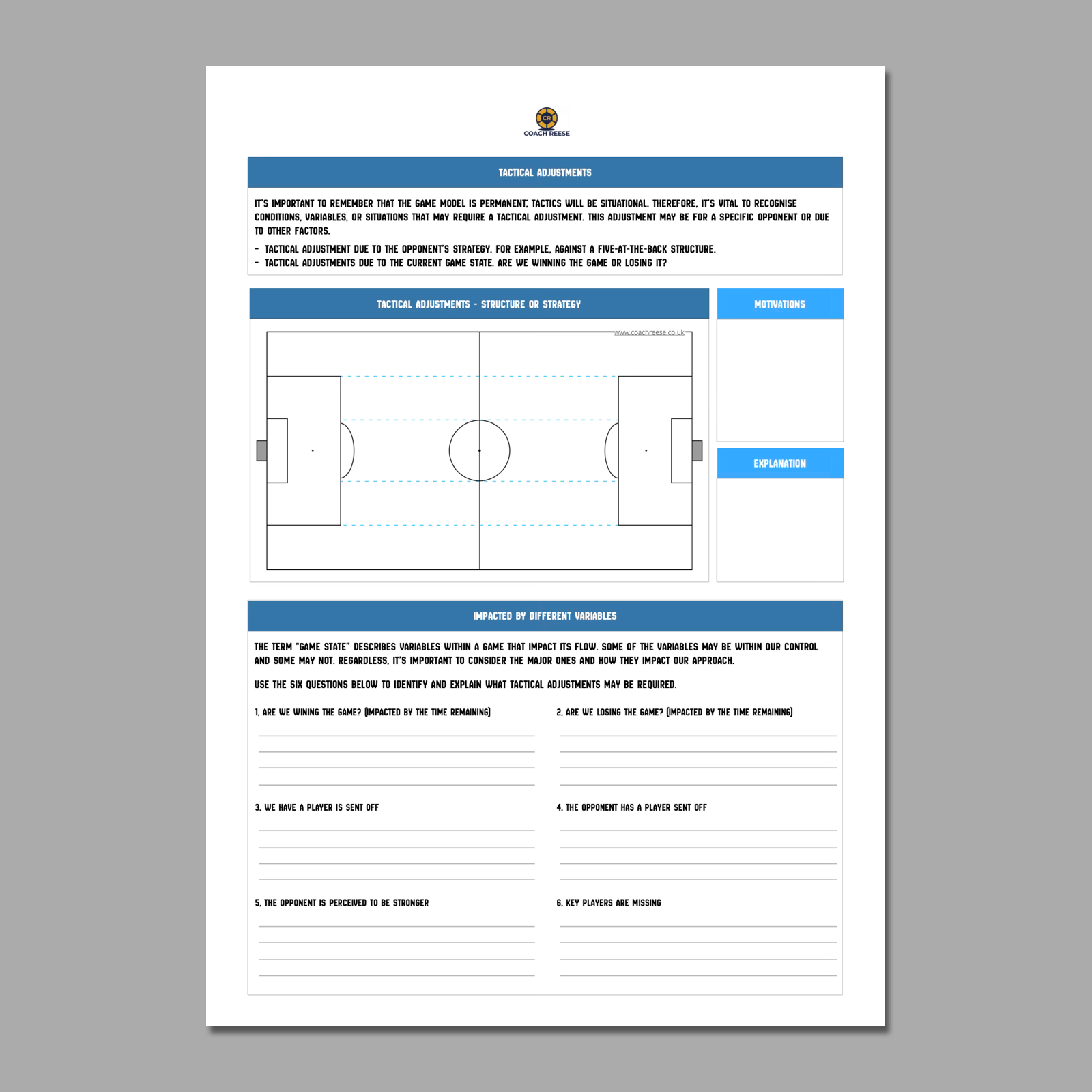
PAGE SIX — TACTICAL ADJUSTMENTS
How Will You Adapt Your Game?
No Game Model should exist in isolation from the game.
Opponents change.
Game states change.
Players change.
Momentum changes.
Your team may need to adapt.
This page helps you consider your tactical adjustments.
What will you change if:
- You are winning?
- You are losing?
- You need a goal?
- You need to protect a lead?
- The opposition changes formation?
- Your press is being beaten?
- You cannot progress through the centre?
- The opposition is creating overloads?
- You need more attacking width?
- You need greater defensive security?
Consider adjustments to:
- Formation
- Structure
- Player roles
- Pressing
- Defensive block
- Width and depth
- Build-up
- Attacking approach
- Substitutions
- Game management
The objective is not to abandon your Game Model.
It is to understand how your principles can adapt to the demands of the game.
A clear Game Model gives you the foundation to make intelligent adjustments.
BUILD YOUR GAME MODEL STEP BY STEP
The six pages take you through a simple process:
1. YOU THE COACH
Understand your beliefs and coaching philosophy.
2. FUNDAMENTAL PRINCIPLES
Define what your team stands for.
3. IN POSSESSION
Define how you want your team to attack.
4. OUT OF POSSESSION
Define how you want your team to defend.
5. TRANSITIONS
Define how your team reacts when possession changes.
6. TACTICAL ADJUSTMENTS
Define how your team can adapt to the demands of the game.
Six pages. One connected Game Model.
CLARITY WITHOUT RIGIDITY
A Game Model should provide players with clarity.
But clarity does not mean removing intelligence.
Your players still need to:
- Scan
- Observe
- Recognise
- Decide
- Adapt
- Communicate
- Solve problems
The Game Model provides reference points.
The players bring those reference points to life.
Structure gives players a framework. Understanding gives them freedom.
FROM PRINCIPLES TO BEHAVIOURS
A useful Game Model connects the big idea to what players actually do.
PRINCIPLE → SUB-PRINCIPLE → BEHAVIOUR
For example:
CREATE SPACE
Principle: Create space.
Sub-principles:
- Create width
- Create depth
- Move opponents
- Create passing lanes
Behaviours:
- Move away from the ball
- Rotate positions
- Provide support
- Attack the space created
- Recognise when to penetrate
This connection makes your Game Model easier to coach, communicate, train and evaluate.
A GAME MODEL FOR YOUR TEAM
There is no single correct Game Model.
Your Game Model should reflect:
- Your football philosophy
- Your players
- Their abilities
- Your team structure
- Your competition
- Your environment
- Your coaching beliefs
- Your development objectives
The important thing is that your ideas are clear, connected and coachable.
A LIVING DOCUMENT
Your Game Model should continue to develop.
As your players develop, your understanding develops.
As your team develops, your Game Model may change.
As you experience different opponents and different game states, new questions emerge.
Use the document to review:
What did we say we wanted to do?
What did we actually do?
What behaviours did we see?
What do we need to develop?
What should we train next?
Your Game Model should evolve with your team.
FOR COACHES
Designed for coaches who want to move from ideas to a clear framework for how their team plays.
Use it to:
- Define your philosophy
- Establish fundamental principles
- Develop attacking principles
- Develop defensive principles
- Define transition behaviours
- Consider tactical adjustments
- Create a common language
- Connect your Game Model to training
- Review and develop your team’s identity
FOR COACH DEVELOPERS & ANALYSTS
Use the framework to help coaches articulate their ideas, evaluate their team’s behaviours and identify the relationship between philosophy, principles, practice and performance.
FOR DEVELOPING COACHES
A simple structure for beginning to think about the game at a deeper level.
Rather than starting with a formation, start with your beliefs.
Rather than simply describing what happened, consider what you want to happen.
Rather than collecting isolated ideas, connect them into a coherent way of playing.
FROM THE PROFESSIONAL GAME
Written from the perspective of a professional football coach and coach developer.
The document is designed to be practical, accessible and relevant to the realities of coaching.
Think clearly. Coach clearly. Develop clearly.
TRUSTED BY PROFESSIONALS
Danny Röhl — Football Manager
Gaël Clichy — Former Manchester City & Arsenal player, Coach
Yohan Cabaye — Former Newcastle United & PSG player, Coach
Martin Devaney — Assistant Manager, Barnsley FC
Marlon Pack — Portsmouth Captain
Kenwyne Jones — Former Premier League player, Coach
Football ideas that can be understood, applied and developed.
DEFINE YOUR FOOTBALL. BUILD YOUR GAME MODEL.
BUILD YOUR FOOTBALL GAME MODEL
A practical six-page framework to help you define:
- You the coach
- Fundamental team principles
- In-possession principles
- Out-of-possession principles
- Transition principles
- Tactical adjustments
- Clear behaviours
- A connected football identity
Six pages. One framework. Your football identity.
For coaches. Coach developers. Analysts. And anyone developing a clear way of playing.
Define it. Build it. Live it.

Reviews
There are no reviews yet.