Have you ever found yourself in the middle of a football debate, whether at the pub or at work on Monday morning, and feeling lost? Well, this is the article for you!
Attempting to understand some of the greatest minds in football will always be challenging, but good news, we can make the process easier.
What is Football?
At its core, football is an invasion game in which both teams attempt to score on their opponent’s goal. Football is generally divided into five phases of play.
In possession: with the ball and attacking
Out of possession: without the ball and defending
Attacking transition: the ball has just been regained.
Defensive transition: the ball has just been lost.
Set pieces: the ball is being returned to open play (throw-in, free kick, etc.).
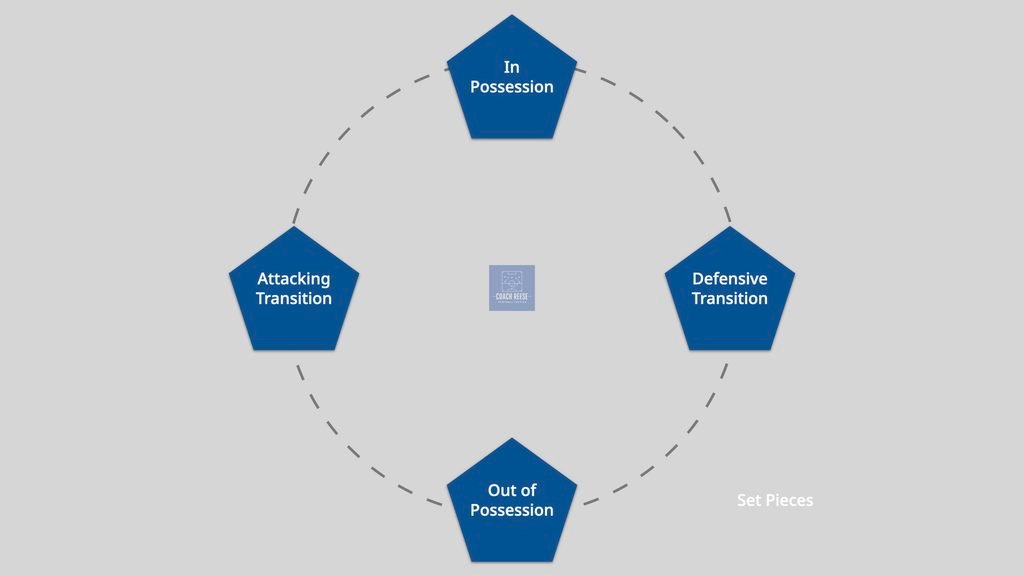
Due to the unpredictable nature of football, there’s no set framework for how a team moves through the different phases of play. At one moment, a team may be defending, then quickly counter-attacking, and soon after, returning to a state of being out of possession.
Choosing One Team
One of the biggest mistakes people make with analysis is attempting to analyse everything at once. It’s just not possible. So what’s the solution? The solution is to begin simplifying the process, allowing us to focus our analysis lens more accurately. This begins with choosing one team; for reference, we’ll call this the focus team.
The First Ten Minutes
With emotions flaring, the first ten minutes of any game typically lack any kind of rhythm or flow. Therefore, as we begin the analysis process, it’s important to avoid fixating on this moment and just start recognising trends.
Is there any consistency in the focus team’s approach?
Where do they generally progress?
How are they typically defending?
Analysing Structure or Shape
The modern game has moved away from relying solely on formation-specific qualities and toward more sophisticated attacking and defensive structures.
So how do we analyse it?
Take a look at the example below from the Everton v Manchester United game last season.
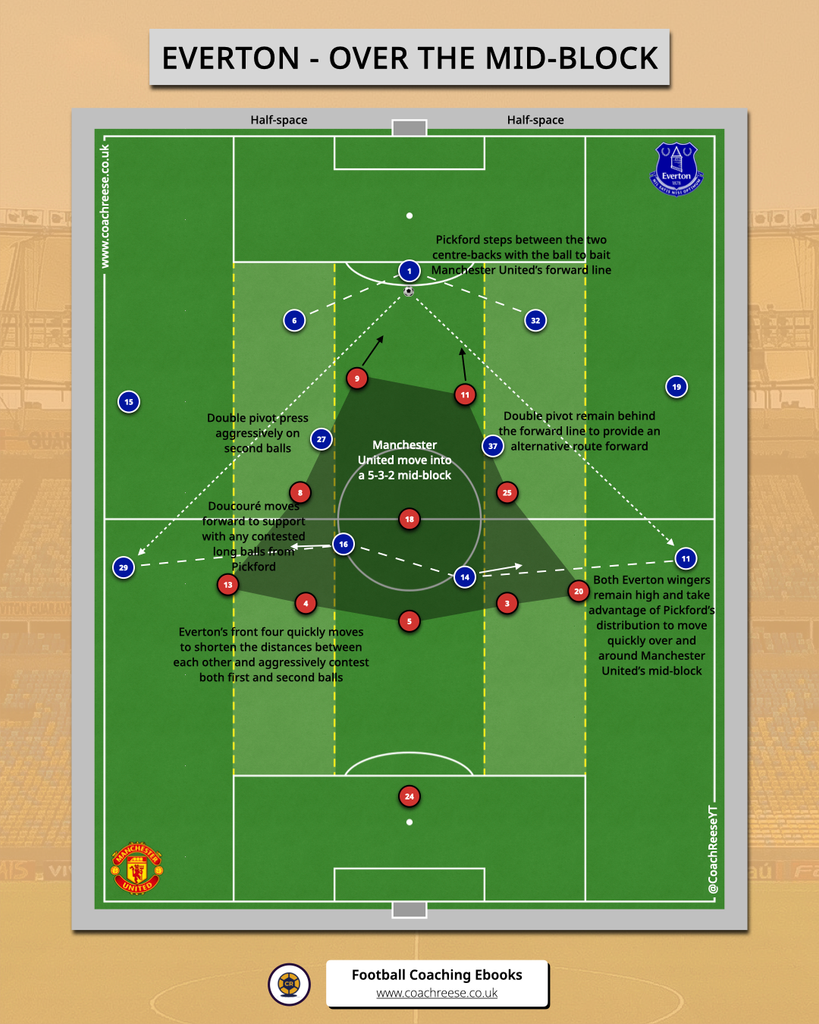
With Manchester United settled within their mid-block, we can begin understanding its structure. To isolate the structure, we have two options: either look at the different lines within it or identify its outer edges. In this example, we can clearly see a 5-3-2 structure.
If we flip it and take a look at Everton, by isolating the position of each attacking player we can quickly recognise a 4-2-4 structure.
A team’s structure will be different from their formation.
Isolate the three or four lines within it.
Identify its outer edges.
Patterns and Trends
The final step is to identify any patterns or trends within the team’s attacking and defensive strategies. Effectively we’re trying to answer the following questions.
Why does it happen? (motivations)
When does it happen? (triggers or cues)
How does it happen? (Who is involved, and how are they involved?)
This does begin to rely on your tactical understanding and observation skills, which are both critical in effective match analysis. Without either, it can be difficult to understand what a team is attempting to achieve.
If you are keen to learn more about the different formations, roles, and football tactics, check out my series of ebooks at https://coachreese.co.uk/
How to Analyse a Football Match
Check out the complete ebook guiding you through the analysis process here https://coachreese.co.uk/product/how-to-analyse-a-football-match/