Posted on

Top Three Session Session Planning Tips

The Football Problem

The first step for planning any session is to identify the “football problem.” A simple example: we’re struggling to score goals from crosses.

Simply by identifying the football problem, the session already begins to plan itself. If the team is able to get the ball into the final third or wide areas, but we can’t score? The session “Attacking from Wide Areas in the Final Third.” 

It may appear really simple, but it generally is!

If you’re working with the younger age groups, again, begin by identifying the football problem. The players are struggling to stay on the ball after they’ve received it. The session “Receiving to Travel with the Ball.” or even simpler, “Dribbling with the Ball.”


What do the Players Need?

The next step is to understand what the players actually need from the session.

Let’s continue with our examples.

If the players in the first example are struggling to score from wide areas, we might need to focus on a specific finishing or crossing technique. Therefore, how we structure the session becomes really important.

The goal is to focus on a specific technique and, importantly, provide the players with the opportunity to achieve significant success with it. The session will probably need to spend some time in an unopposed practice. This approach is probably the same for the younger group who are struggling to move with the ball. 

There’s no perfect solution to football or training, and it’s important to understand the tradeoffs of every decision we make. 

We need to ensure that players have the opportunity to practice a specific action or technique without pressure, as they require some success. We naturally sacrifice some element of realism for a high amount of repetition. This will be the same the other way around. Lots of realism typically loses repetition. 


Structuring the Session

The final step is to actually begin structuring the session and considering the different practices within it.

A general guideline is that “players will typically remain engaged in a given practice for twice their age.” For example, for a team of under 10s, one practice should be no longer than 20 minutes. Therefore, a one-hour session should involve three practices.

Continuing with our finishing example, a 60-minute session could be structured in the following ways.

Up the Ladder

Practice One – Unopposed Finishing Practice 

Lots of repetition, success, and the opportunity to refine a technique.

Practice Two – Unopposed with Interference or Matched Up

Introduce active or passive pressure to challenge the individual and begin moving the session towards a more realistic setting.

Practice Three – Matched Up or Small-Sided Game

This exercise has the highest level of realism. This practice usually involves two or three teams playing a conditioned game. This approach will increase realism while challenging the individual’s decision-making and technique.


Session Planning is a Personal Process

There’s no perfect way to plan a session; it’s important to find a way that works for you and the players in the team.

Hopefully you’ve found one or all of the three tips useful. Good luck with your next session!
Posted on

Support Around and Away from the Ball

How it works
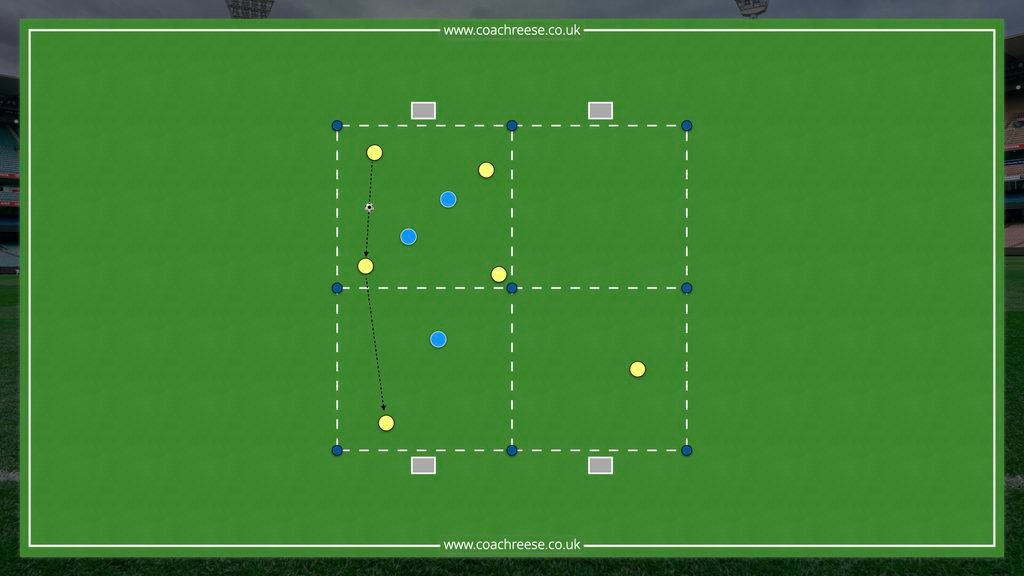
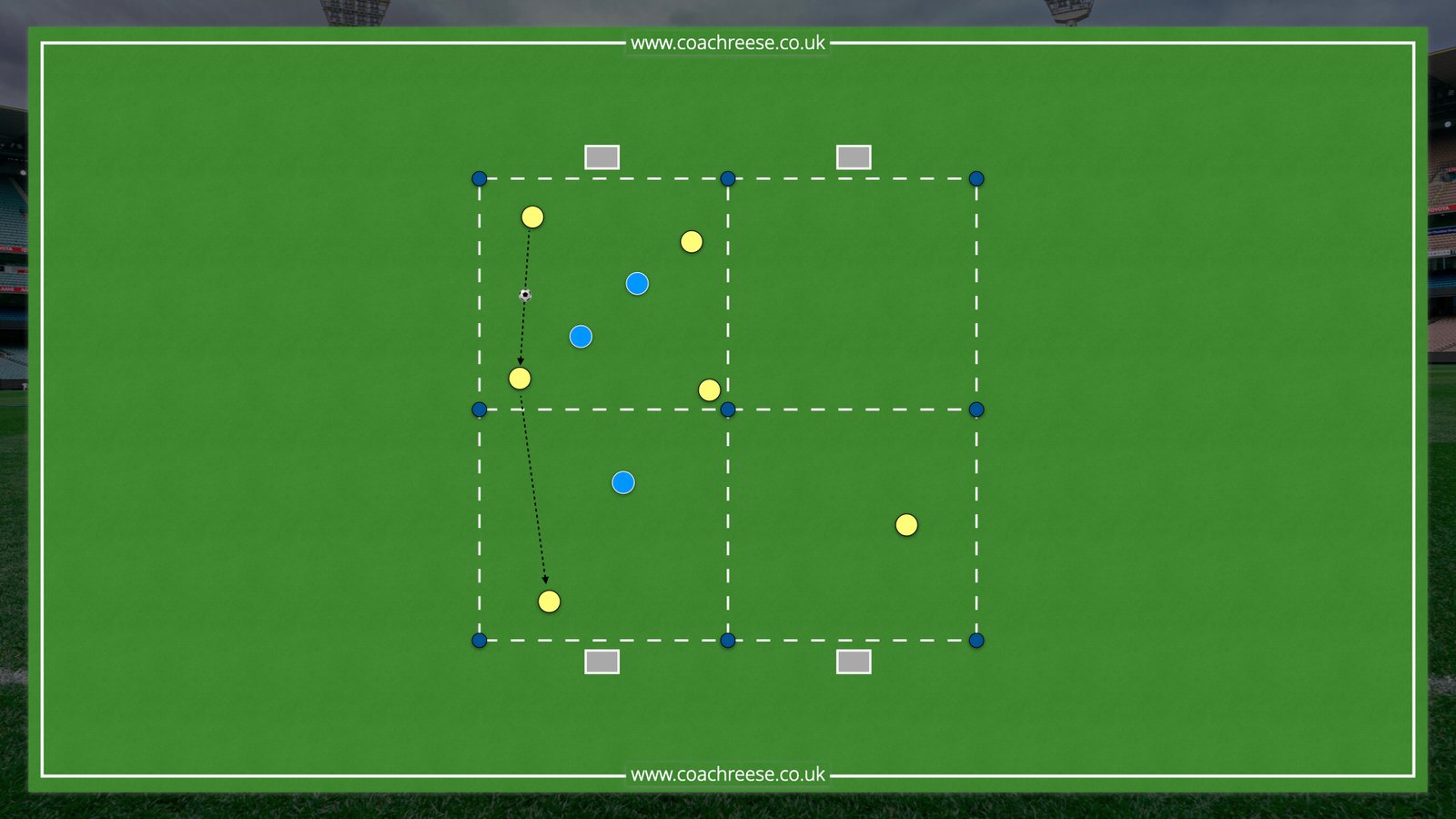
5v3

The attacking team will attempt to retain the ball for a given number of passes before scoring on any mini-goal. Importantly, the can only have three players in a quarter at any point.

The defending team of three should attempt to win the ball before scoring on any min-goal. Importantly, the can only have two players in a quarter at any given point.

Key Coaching Points

Around the ball
Maintain four contact points at all times
Distance/ angle/ body shape to retain the ball and play away from congestion
Technical execution (passing and receiving)
Decision-making process (scanning/ assess surroundings/ opponent/ teammates)

Away from the ball
Be ready to receive the ball
Be positioned at a distance that provides time for any teammates to arrive
Draw pressure to create space

Checkout the Coaching ebooks at https://coachreese.co.uk/product-category/coaching-series/

Posted on

Rewarding the Press – Small-sided Game

This really simple small-sided game is perfect for encouraging players to press their opponent.

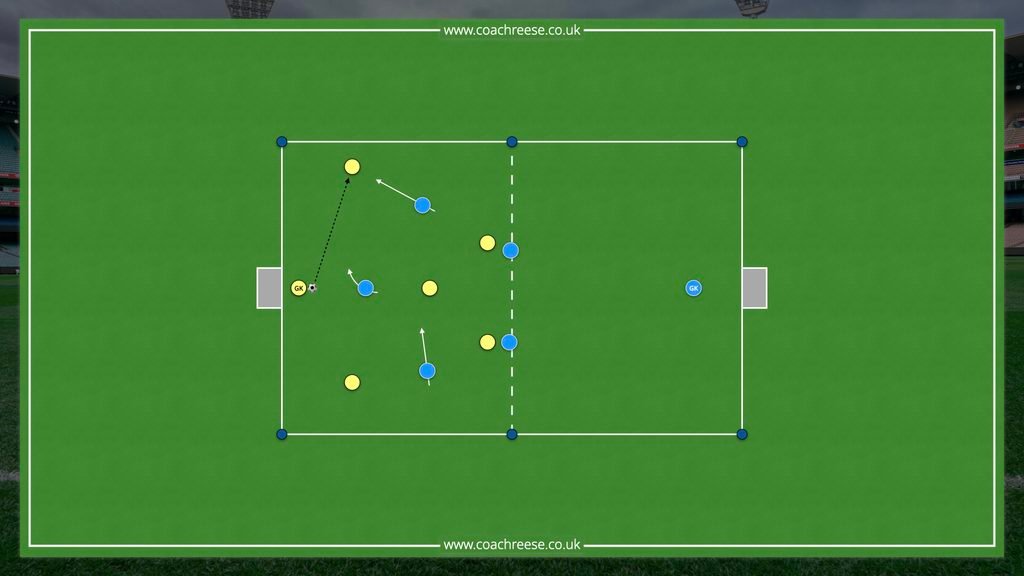
Area Size: 50×30 (adjust for the age and ability of the players)
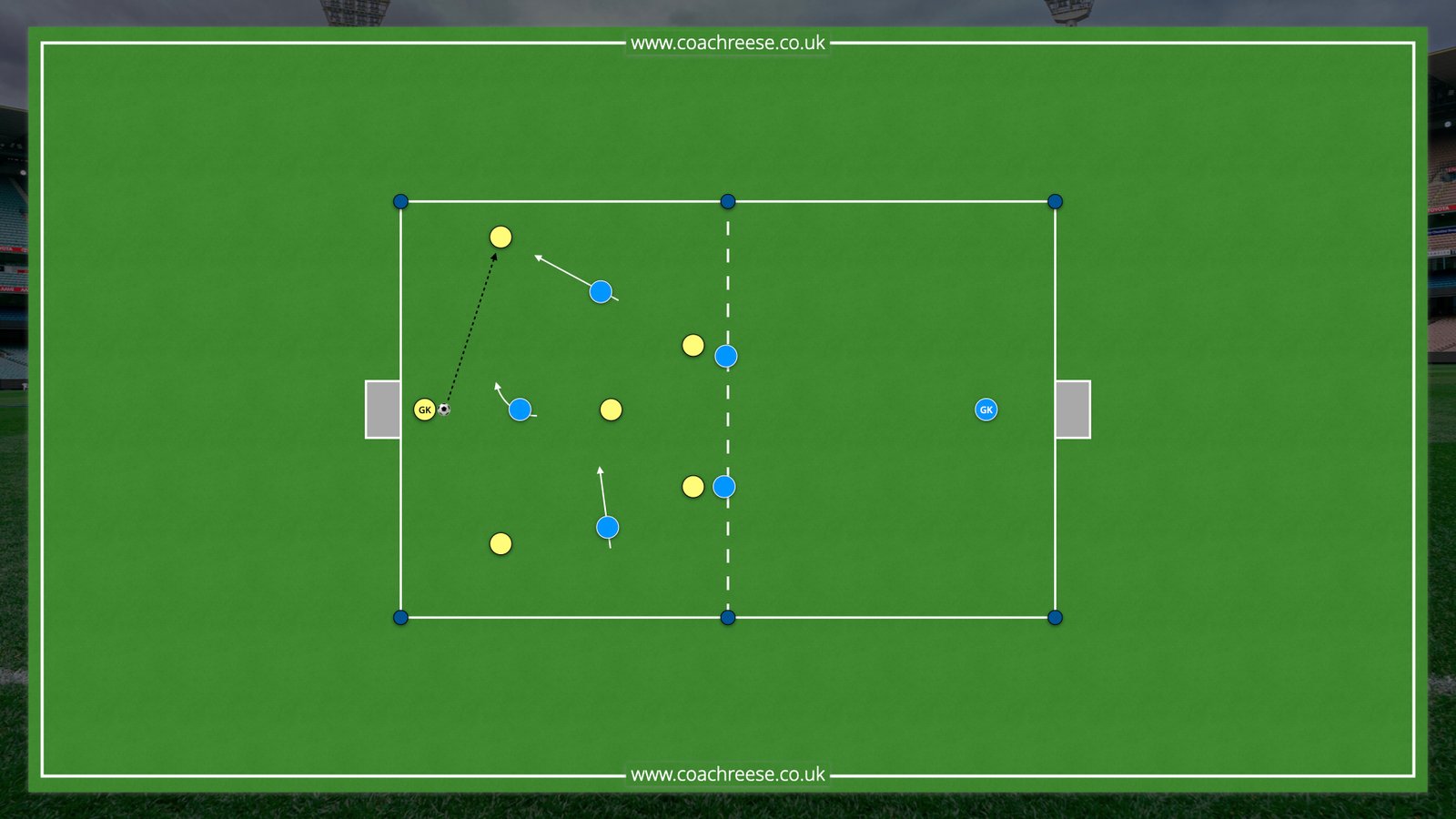
5v5 (+GK)

The Practice

How it Works

The area is divided into two by a halfway line. The practice plays as a normal game with the two teams attempting to score on their opponent’s goal. If the defending team can regain the ball in their opponent’s half of the pitch and score. This goal will be worth two points.

Coaching Points

  • Press (primary contact or closest player), cover (secondary contact), and balance (tertiary contact).
  • As the ball moves and the defending players’ proximity to it changes, the roles also change.
  • Dictate how and where the attacking team progresses.
  • Make the attacking team’s play predictable.
  • It’s critical that the players move together as the ball moves.
  • Limit the attacking team’s available space.

Posted on

Liverpool v Nottingham Forest Half-time Analysis

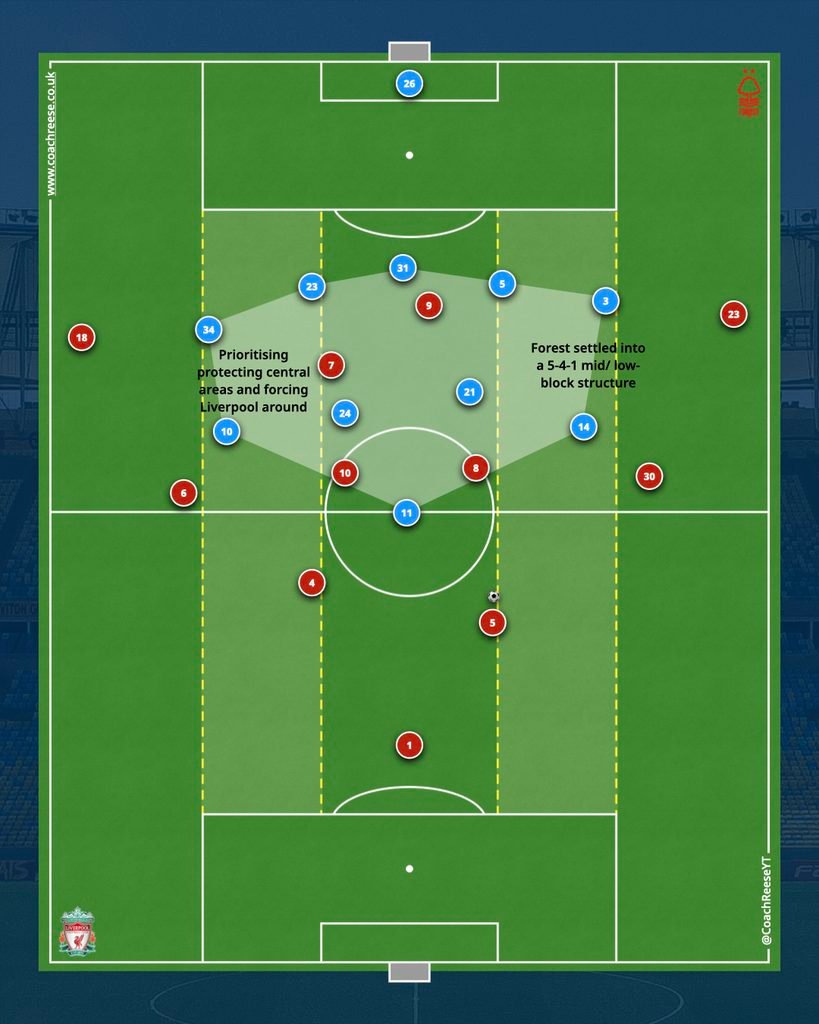
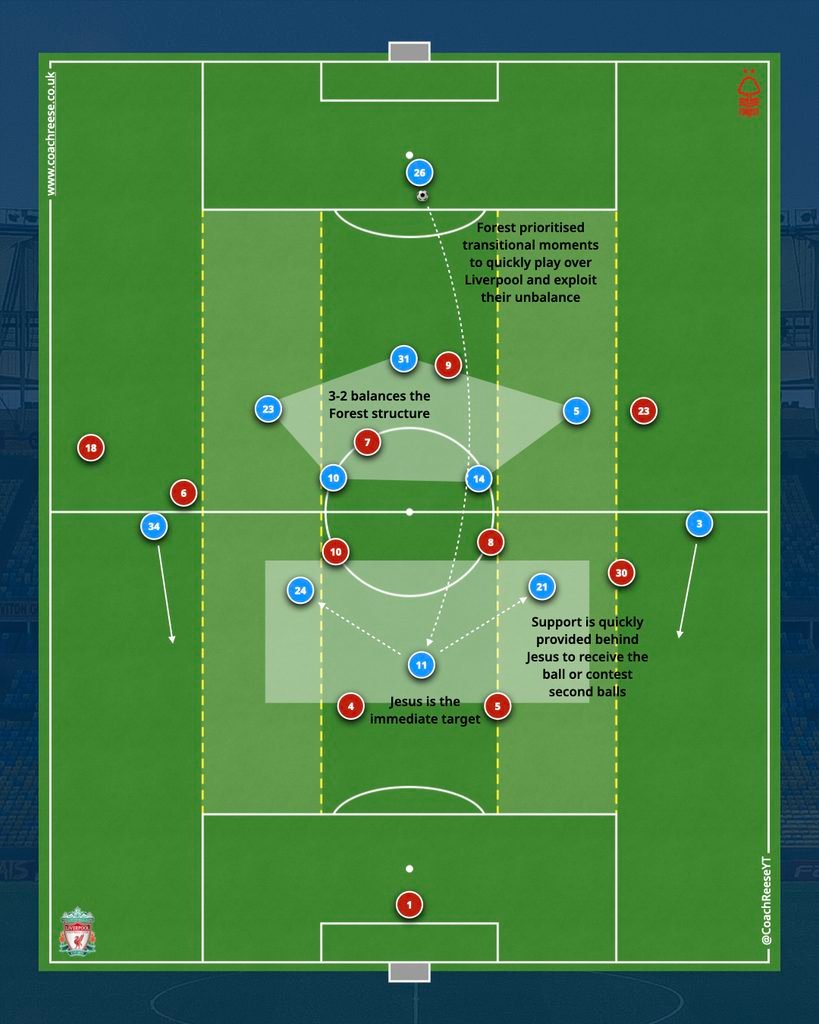
Nottingham Forest settled into a 5-4-1 mid/low-block with the two attacking midfielders moving alongside the double pivot. Protecting central areas, limiting their access to key players (Isak/ Wirtz) and forcing Liverpool towards more vulnerable locations.

Forest typically prioritised transitional moments with the intention of moving over Liverpool as they attempt to reorganise. This generally involved playing a longer, more direct pass towards Jesus. Importantly, the two attacking midfielders provided immediate support to either continue counter-attacking or contest second balls.

The 3-2 structure allowed Forest to balance their structure as the wing-backs moved forward to support.

Do you want to learn how to analyse football matches? Check out the ebook at https://coachreese.co.uk/product/how-to-analyse-a-football-match/

Posted on

How to Analyse a Football Match

Have you ever found yourself in the middle of a football debate, whether at the pub or at work on Monday morning, and feeling lost? Well, this is the article for you!

Attempting to understand some of the greatest minds in football will always be challenging, but good news, we can make the process easier.

What is Football?

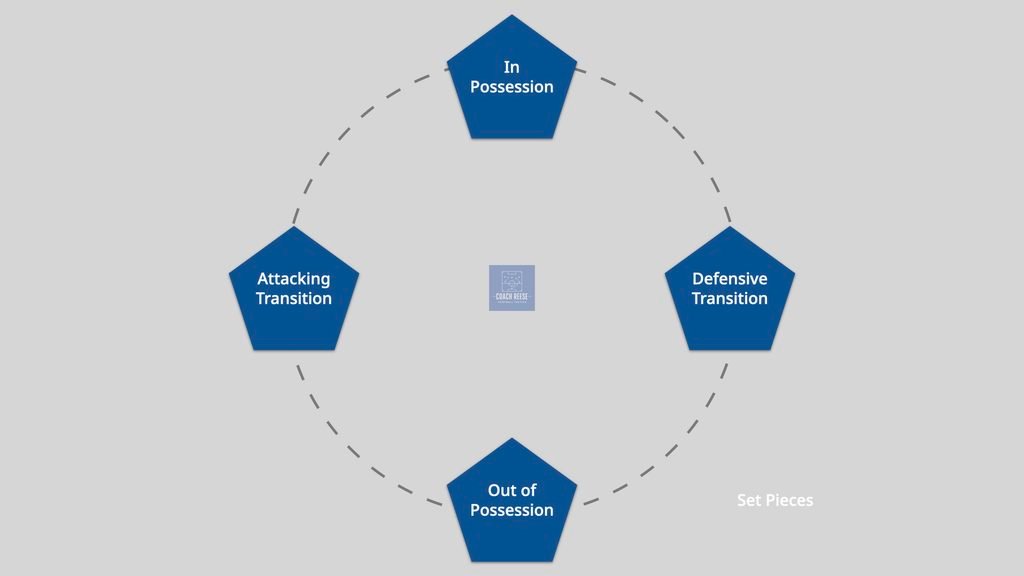
At its core, football is an invasion game in which both teams attempt to score on their opponent’s goal. Football is generally divided into five phases of play. 

In possession: with the ball and attacking

Out of possession: without the ball and defending

Attacking transition: the ball has just been regained.

Defensive transition: the ball has just been lost.

Set pieces: the ball is being returned to open play (throw-in, free kick, etc.).

Due to the unpredictable nature of football, there’s no set framework for how a team moves through the different phases of play. At one moment, a team may be defending, then quickly counter-attacking, and soon after, returning to a state of being out of possession.

Choosing One Team

One of the biggest mistakes people make with analysis is attempting to analyse everything at once. It’s just not possible. So what’s the solution? The solution is to begin simplifying the process, allowing us to focus our analysis lens more accurately. This begins with choosing one team; for reference, we’ll call this the focus team.

The First Ten Minutes

With emotions flaring, the first ten minutes of any game typically lack any kind of rhythm or flow. Therefore, as we begin the analysis process, it’s important to avoid fixating on this moment and just start recognising trends.

Is there any consistency in the focus team’s approach?

Where do they generally progress?

How are they typically defending?

Analysing Structure or Shape

The modern game has moved away from relying solely on formation-specific qualities and toward more sophisticated attacking and defensive structures.

So how do we analyse it?

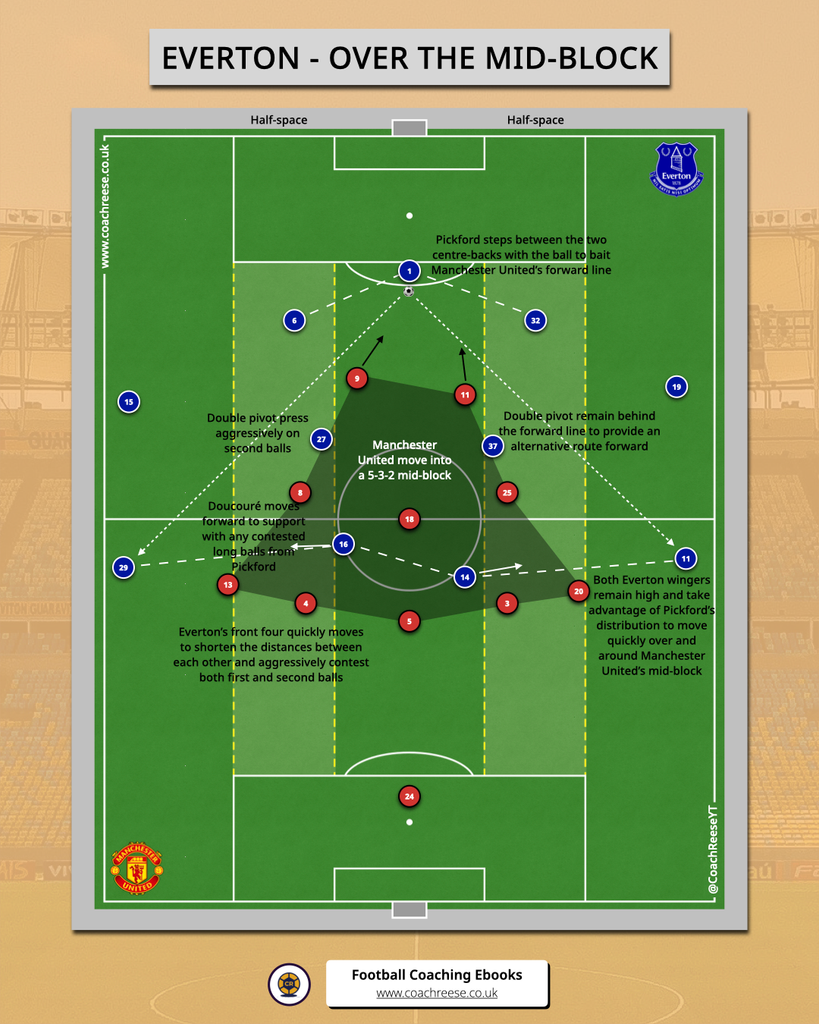
Take a look at the example below from the Everton v Manchester United game last season.

With Manchester United settled within their mid-block, we can begin understanding its structure. To isolate the structure, we have two options: either look at the different lines within it or identify its outer edges. In this example, we can clearly see a 5-3-2 structure.

If we flip it and take a look at Everton, by isolating the position of each attacking player we can quickly recognise a 4-2-4 structure.

A team’s structure will be different from their formation.

Isolate the three or four lines within it.

Identify its outer edges.

Patterns and Trends

The final step is to identify any patterns or trends within the team’s attacking and defensive strategies. Effectively we’re trying to answer the following questions.

Why does it happen? (motivations)

When does it happen? (triggers or cues)

How does it happen? (Who is involved, and how are they involved?)

This does begin to rely on your tactical understanding and observation skills, which are both critical in effective match analysis. Without either, it can be difficult to understand what a team is attempting to achieve. 

If you are keen to learn more about the different formations, roles, and football tactics, check out my series of ebooks at https://coachreese.co.uk/

How to Analyse a Football Match

Check out the complete ebook guiding you through the analysis process here https://coachreese.co.uk/product/how-to-analyse-a-football-match/

Posted on

The Importance of the Coaching Position

The coaching position is a vital asset in a coach’s armoury. The position from which we stand will have a huge impact on how we influence players during a session, as it affects our visibility, communication, and capacity to successfully engage with individuals. Understanding the importance of the coaching position begins to move a coach’s attention from facilitation to coaching, allowing the coach to better engage with players and adjust their approach to individual requirements throughout practice.

What impacts where we stand?

  • The topic of the practice and session
  • Can I see what the focus players will see?
  • Can I recreate the same picture if something goes wrong?

Examples:

Facilitating a Session

A Coaching Position for a Defensive Focus

A Coaching Position for an Attacking Focus

The focus of the practice will impact where we stand. With a defensive focus it will be more appropriate to stand in a position that allows us to see what the defenders in the practice will. For an attacking topic, the same process will apply. Can we stand in a position to see what the attacking team will see?

Posted on

Coaching Strategy On, Around, and Away

The terms “on”, “around”, and “away” are used to describe three contact points a coach can use within a game or training session to provide support to a player, unit, or team.

Coaching On

This refers to the individual with the ball. Typically the first contact point within a training session, the coach must consider the individual’s technical execution and their decision-making process.

Firstly, consider what the individual is seeing. What key observation points are they searching for, teammates, space, and the opponent. How does each one impact the decision-making process of the individual?

Coaching Around

This refers to the teammates in the immediate vicinity of the ball carrier and should be the second contact within a training session.

It’s important to consider how the individual’s support the ball carrier. What positions do they take up? Are they at an appropriate distance? Positioned at an angle? What is their body shape? If one of the players is to receive the ball, the process will move to coaching “on”. Therefore, considering the individual’s technical execution and decision-making process?

Coaching Away

The final contact point for a coach, coaching away, considers the players who may not receive the ball in the immediate moments but should still be impacting the game.

The players in this area will typically be impacting the opponent or pitch by creating maximum structural height, width, or depth. It’s also important to consider how these individuals remain connected to the game. Are they scanning, observing, and assessing their surroundings to consider how they may impact the game or provide support to the teammates on and around the ball. Is the individual prepared to become active should the ball move?