
Description
THE GAME MODEL
Define How You Want Your Team to Play.
A practical guide to understanding, developing and implementing a Game Model in football.
What is a Game Model?
What is a coaching philosophy?
How do your beliefs about football influence the way your team plays?
How do you turn your philosophy into a clear Game Model?
What should your team look like with the ball?
What should your team look like without it?
How should your team behave during transitions?
How do you connect your Game Model to your training?
And how do you develop a Game Model that is clear, consistent and adaptable?
Written by a professional football coach and coach developer, this book takes you through the process of understanding and developing a Game Model — from the ideas and philosophy behind it to its practical application on the training pitch and matchday.
Whether you’re a coach, coach developer, analyst, player or football aficionado, this book provides a practical framework for understanding how teams develop an identity and turn that identity into action.
MORE THAN JUST A GAME MODEL
A Game Model is more than a collection of formations, tactics or training practices.
It represents how you want your team to play.
It connects your beliefs about football with the behaviours you want to see from your players.
How do you want your team to attack?
How do you want your team to defend?
How do you want your team to react when possession changes?
How do you want your players to behave in different phases of the game?
And what principles will guide their decisions?
This book explores the Game Model as a framework for creating a clear football identity.
UNDERSTANDING THE GAME MODEL
Before you can build a Game Model, you need to understand what it actually is.
Explore:
- What a Game Model is
- Why it matters
- The relationship between philosophy and Game Model
- Principles of play
- Sub-principles
- Team behaviours
- Individual behaviours
- Phases of play
- Transitions
- Tactical intentions
- Decision-making
- Training methodology
Understand how the different components connect to create a coherent model for how your team plays.
COACHING PHILOSOPHY
Every Game Model starts with beliefs.
What do you believe about football?
How do you believe the game should be played?
What do you value?
What do you want your team to represent?
Your coaching philosophy provides the foundation for your Game Model.
Explore the relationship between:
Your beliefs.
Your values.
Your football philosophy.
Your principles.
Your behaviours.
Your Game Model.
Understand how abstract ideas can be transformed into clear football behaviours.
FROM PHILOSOPHY TO PRACTICE
Having a philosophy is one thing.
Turning it into something your players can understand and execute is another.
The book explores how to move from:
What you believe
to
How you want your team to play
to
What you want your players to do
to
How you train it
to
How you recognise it in matches.
Build a connection between your coaching ideas and the football your team actually produces.
BUILDING YOUR GAME MODEL
This book provides a practical framework for developing your own Game Model.
Explore how to establish:
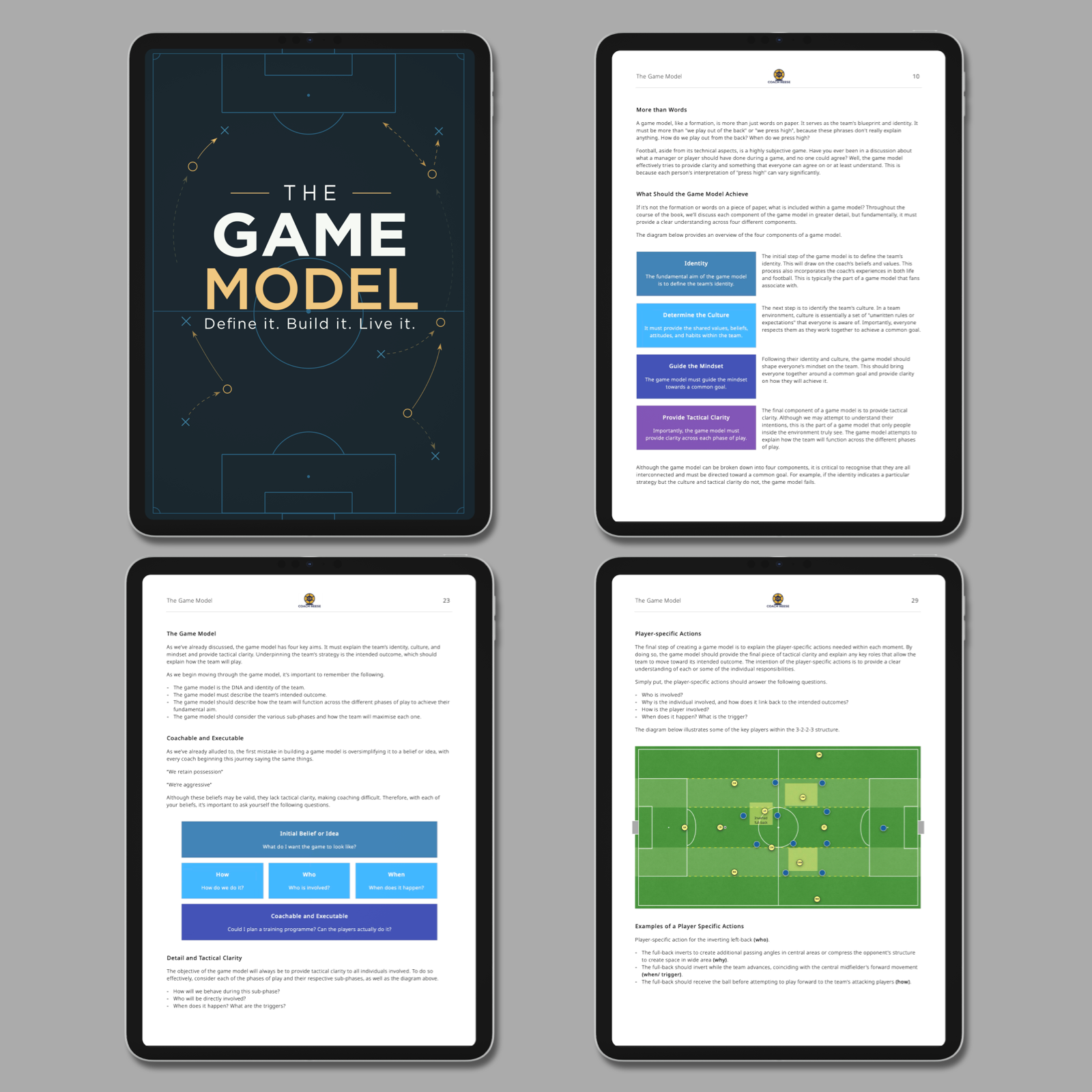
TEAM IDENTITY
What do you want your team to be known for?
PRINCIPLES
What are the key principles that guide your team’s behaviour?
SUB-PRINCIPLES
How can those principles be translated into more specific behaviours?
PLAYER BEHAVIOURS
What do you want individual players to see, understand and execute?
TEAM BEHAVIOURS
How should players work together to achieve the desired outcomes?
PHASES OF PLAY
What should your team look like throughout the different phases of the game?
TRANSITIONS
How should your team react when possession changes?
Build a Game Model that provides clarity without removing the intelligence and adaptability of the players.
THE GAME MODEL ACROSS THE PHASES
A Game Model needs to explain how your team behaves throughout the game.
Explore your team’s intentions during:
BUILD-UP
How do you want to start attacks?
How do you create solutions against pressure?
How do you progress the ball?
MOVING THROUGH THE PITCH
How do you want to advance possession?
How do you create and exploit space?
How do players support progression?
CREATING & EXPLOITING SPACE
How do you want your team to manipulate opponents?
How do you create advantages?
How do you attack spaces?
CHANCE CREATION
How do you want your team to create opportunities?
What behaviours do you want to see in the final third?
DEFENSIVE ORGANISATION
How do you want your team to defend?
How do you control space?
How do you protect the goal?
PRESSING
When do you want to press?
What are your triggers?
Where do you want to regain possession?
TRANSITIONS
What happens immediately after winning or losing the ball?
How quickly should your team react?
Understand how your Game Model creates consistent principles across every phase of the game.
PRINCIPLES & SUB-PRINCIPLES
A Game Model becomes useful when your players understand the behaviours behind it.
Explore how broad principles can be developed into more specific sub-principles.
For example:
Create space.
becomes:
How do we create it?
Where do we create it?
Who creates it?
Who exploits it?
What happens if the opponent prevents it?
Turn broad tactical ideas into clear, observable behaviours.
THE COACHING PROCESS
A Game Model doesn’t exist on paper.
It has to be coached.
Explore how coaches can use:
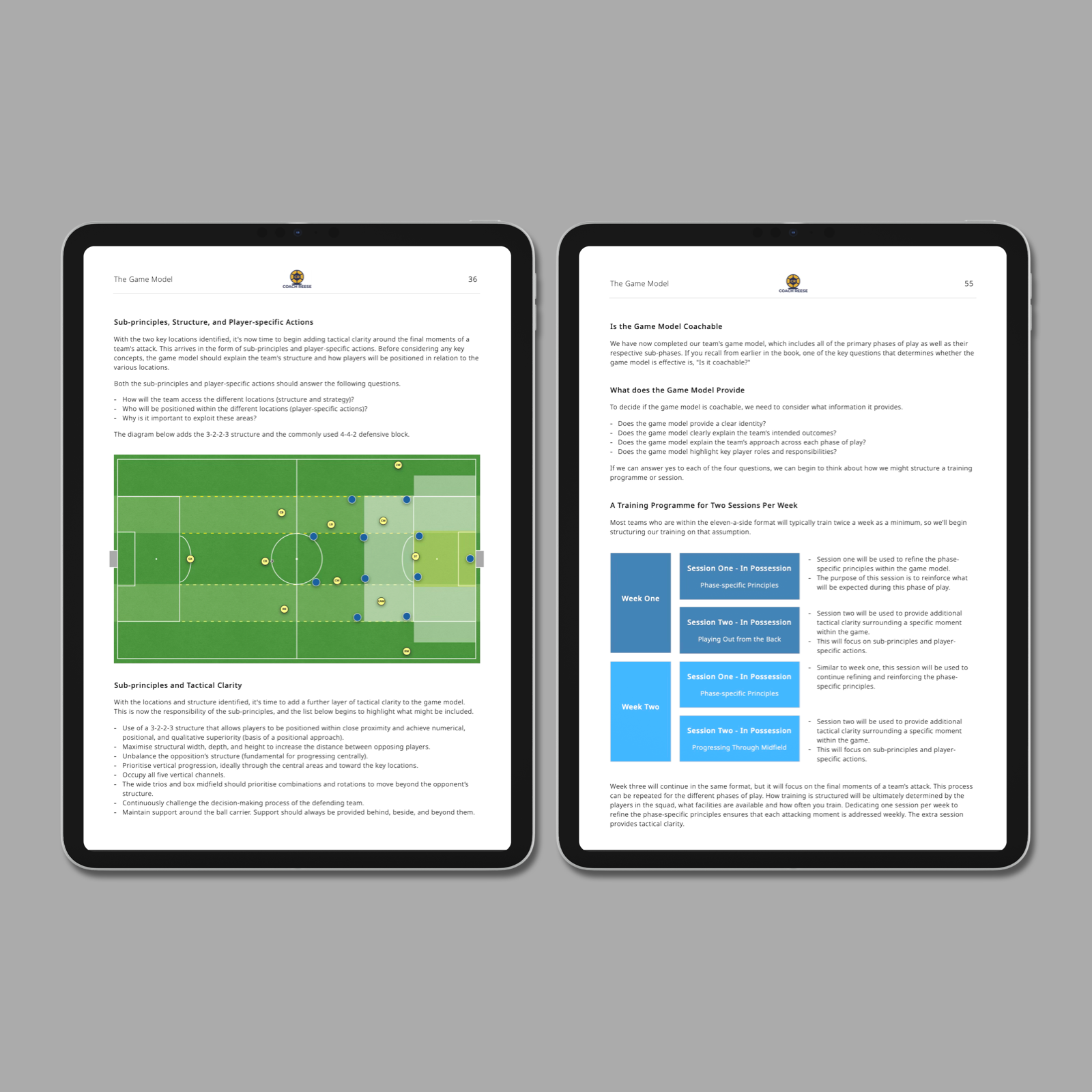
- Training design
- Practice design
- Constraints
- Coaching interventions
- Questions
- Feedback
- Observation
- Reflection
- Match analysis
- Individual development
- Team development
Understand how your Game Model can become the reference point for your coaching process.
TRAINING THE GAME MODEL
If you want your team to play a certain way, you need to train the behaviours required to play that way.
Explore how to connect your Game Model with:
Practice design.
Session objectives.
Principles of play.
Player behaviours.
Team behaviours.
Decision-making.
Game realism.
The aim is to create practices that don’t simply develop isolated skills, but help players understand and execute the behaviours required by your Game Model.
THE ELITE EXAMPLE
Theory becomes more powerful when you can see it applied.
The book includes an elite Game Model example, providing insight into how the principles, behaviours and ideas can come together within a high-level football environment.
Explore how an elite environment can translate:
Philosophy → Principles → Behaviours → Training → Performance.
See how a Game Model can provide a common language and framework for coaches and players working at the highest level.
THE DEVELOPMENTAL EXAMPLE
Game Models aren’t only for elite football.
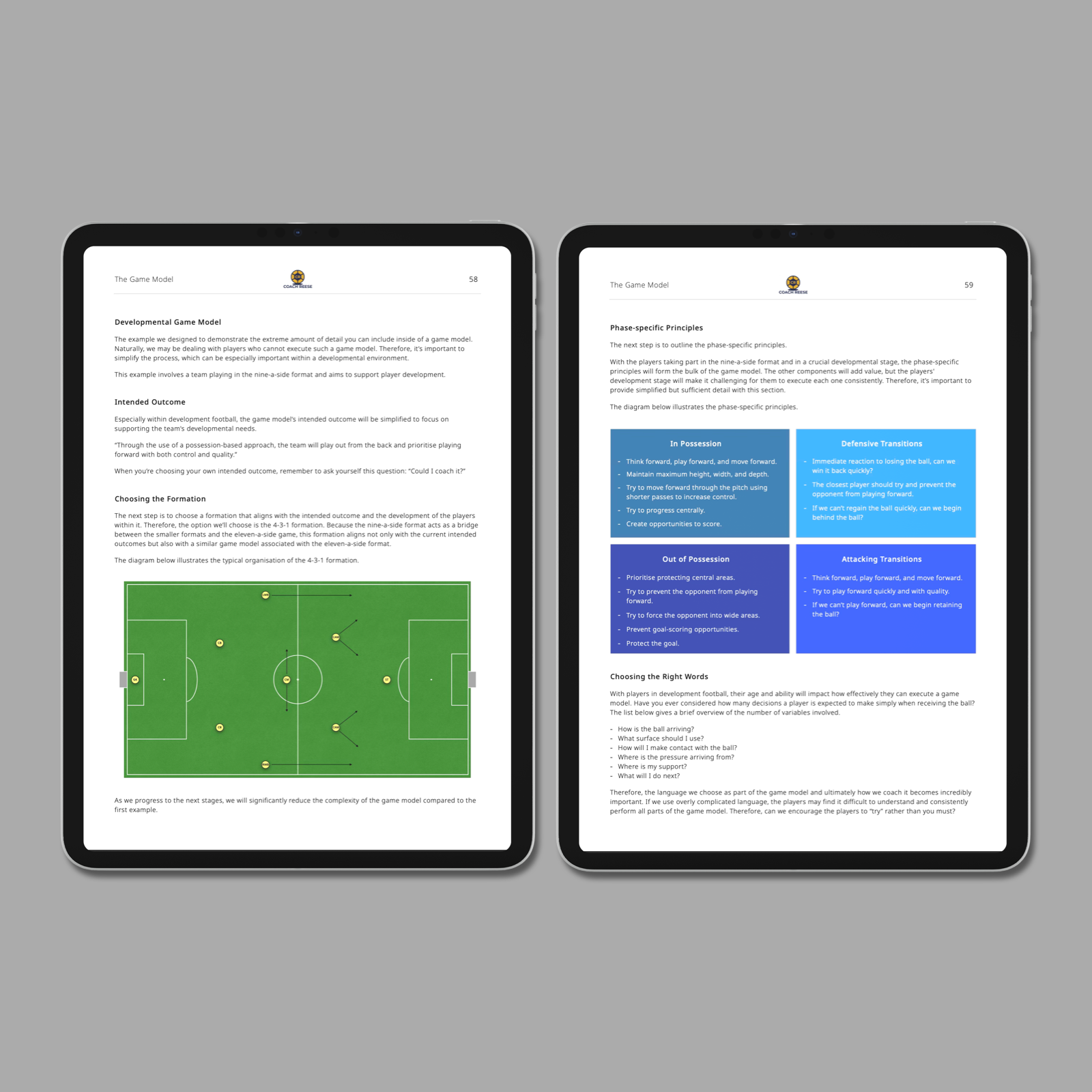
The book also includes a developmental example, showing how Game Model principles can be adapted to a developing football environment.
Explore how coaches can consider:
- Age
- Experience
- Ability
- Learning needs
- Player development
- Training environment
- Competition
- Long-term development
Understand that a Game Model doesn’t need to be unnecessarily complicated to be effective.
It needs to be appropriate for the players and environment.
THE GAME MODEL & PLAYER DEVELOPMENT
A Game Model should help players develop — not simply tell them what to do.
Explore how coaches can use a Game Model to develop:
Understanding.
Decision-making.
Adaptability.
Tactical awareness.
Technical execution.
Problem-solving.
Help players understand the why behind the behaviour, rather than simply memorising instructions.
CLARITY WITHOUT RIGIDITY
One of the biggest challenges for coaches is finding the balance between structure and freedom.
How much should you coach?
How much should you prescribe?
Where should players have freedom?
How do you create clear principles without creating predictable players?
A strong Game Model provides reference points for decision-making, while allowing players to adapt to the constantly changing nature of football.
ADAPTING THE GAME MODEL
Football doesn’t always go according to plan.
Opponents change.
Players change.
Competitions change.
Game states change.
Your own team develops.
Your Game Model therefore needs to provide clarity and adaptability.
Explore how coaches can maintain their core identity while adapting to:
- Different opponents
- Different game states
- Different player profiles
- Different levels
- Different environments
- Different phases of development
The Game Model becomes a framework, not a rigid script.
WATCH FOOTBALL THROUGH THE GAME MODEL
Once you understand Game Models, you start watching football differently.
You begin asking:
What is this team trying to achieve?
What are their principles?
What behaviours are they trying to create?
How do they build the attack?
How do they defend?
What happens when they lose possession?
What triggers their press?
How do their training principles appear in the match?
Learn to recognise the connection between philosophy, principles, behaviours and performance.
FOR COACHES WHO WANT TO DEVELOP AN IDENTITY
You don’t need to be coaching at the highest level to benefit from understanding Game Models.
Whether you’re working in grassroots football, academy football, senior football or an elite environment, this book provides a framework for thinking about:
How you want your team to play.
Why you want them to play that way.
How you communicate it.
How you train it.
How you evaluate it.
And ultimately:
How you develop it.
FOR COACH DEVELOPERS & ANALYSTS
The Game Model also provides a valuable framework for analysing and developing football environments.
Understand how to identify:
- Principles
- Behaviours
- Training connections
- Performance indicators
- Tactical intentions
- Areas for development
Use the Game Model as a common reference point for observation, analysis and feedback.
TRUSTED BY PROFESSIONALS
The author’s eBooks are already being used and endorsed by professionals from the game.
Including:
Danny Röhl — Football Manager
Gaël Clichy — Former Manchester City & Arsenal player, Coach
Yohan Cabaye — Former Newcastle United & PSG player, Coach
Martin Devaney — Assistant Manager, Barnsley FC
Marlon Pack — Portsmouth Captain
Kenwyne Jones — Former Premier League player, Coach
Their use and support of the author’s work reflects the practical focus behind the books:
Football ideas that can be understood, applied and developed.
WRITTEN FROM THE PROFESSIONAL GAME
The author is a professional football coach and coach developer, bringing together practical coaching experience with a passion for helping coaches develop their understanding of the game.
The result is a practical resource that connects football philosophy, Game Model development, coaching methodology and player development.
Useful for coaches.
Valuable for coach developers.
Helpful for analysts.
Relevant to players.
And accessible to anyone interested in understanding how football teams develop an identity.
DEFINE YOUR GAME. DEVELOP YOUR TEAM.
Understand your philosophy.
Define your principles.
Develop your behaviours.
Build your Game Model.
Train your Game Model.
Coach your Game Model.
Evaluate your Game Model.
Adapt your Game Model.
Develop your players.
Develop your team.
THE GAME MODEL
A practical guide to understanding and developing a Game Model in football.
Coaching philosophy.
Game Model principles.
Sub-principles.
Team behaviours.
Player behaviours.
Phases of play.
Transitions.
Training methodology.
Elite Game Model example.
Developmental Game Model example.
Professional coaching insight.
For coaches. Coach developers. Analysts. Players. And football aficionados.
Define how you want your team to play.
Build the framework. Develop the behaviours.
Get your copy today.
Reviews
There are no reviews yet.